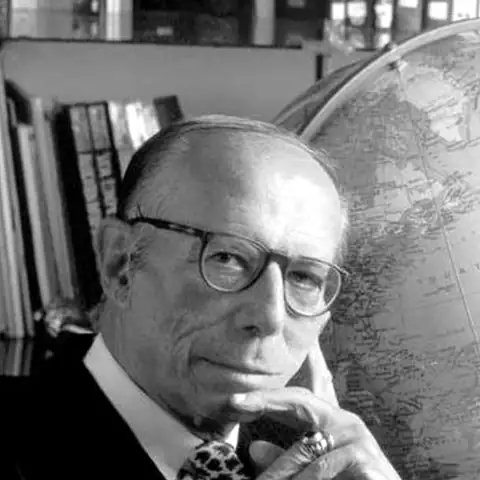
Who was Roberto Campos?
Born in Cuiabá, Roberto de Oliveira Campos spent his youth in Catholic seminaries, where he studied theology and philosophy, before turning to diplomacy. He was present at the Bretton Woods conference in 1944. In the early 1950s he helped build the national development bank, BNDE, and under Kubitschek he ran it. In the military government of Castelo Branco, from 1964 to 1967, he served as planning minister and was a co-author of the economic plan called PAEG. Later he was Brazil's ambassador in London, a senator for Mato Grosso and a congressman for Rio de Janeiro. He published the memoir A Lanterna na Popa in 1994, and in 1999 he took a seat in the Brazilian Academy of Letters.
Political views
- In 1964 he designed a plan to fight inflation built on budget discipline, limits on wages and indexing of contracts.Source: www18.fgv.br
- He helped write the 1964 banking law that set up the Central Bank and the National Monetary Council.Source: planalto.gov.br
- In 1966 he created the FGTS, a savings account for workers that replaced the guarantee of a job after ten years of service.Source: planalto.gov.br
- He argued against the reserve for the computer industry, which shut foreign companies out of Brazil's informatics market.Source: planalto.gov.br
- During the 1990s he pushed to end state monopolies, privatize, reform pensions and cut regulation, and he supported selling the mining giant Vale do Rio Doce.Source: www18.fgv.br
- He opposed calling a fresh constituent assembly during the 1980s. He disliked the 1988 charter enough to say he would not sign it, and only changed his mind after being persuaded.Source: www18.fgv.br
Legacy
Campos is often named among Brazil's most influential economists of the past century. Liberals treat him as a guide: he warned early about inflation, state monopolies and protection, and they say the sell-offs of the 1990s proved him right. Some of what he built, like the Central Bank and housing finance, survived the regime that launched it. Critics on the left, and defenders of state-led development, argue that wages fell in real terms under his 1964-1967 plan and that scrapping job tenure left workers weaker. Others blame him for serving a military government that took away political rights and for helping shape its 1967 Constitution. His newspaper columns and memoir made him a sharp-tongued polemicist who mocked economic nationalism.