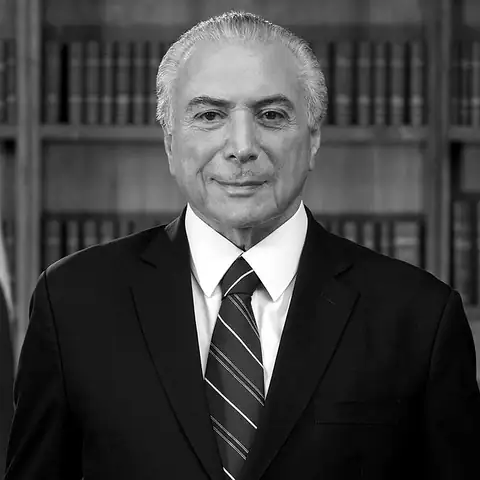
Who is Michel Temer?
Michel Temer was born in 1940 in Tietê, São Paulo state, the child of Lebanese immigrants. He earned a law degree at the University of São Paulo, lectured on constitutional law and ran public security for the state of São Paulo before joining Congress in 1987. He chaired the lower house three times and led the PMDB for a long time. Brazilians elected him vice president twice, in 2010 and 2014, on Dilma Rousseff's ticket. He turned against her in 2015. When the Senate suspended her in May 2016, he took charge, and he became president in August. He did not seek a second term in 2018. He has no public post but stays in the MDB. In October 2026 he openly supported Senator Flávio Bolsonaro in the presidential runoff.
Political views
- Drove through a 2016 constitutional amendment that caps federal primary spending for two decades, allowing growth only to match inflation.Source: planalto.gov.br
- Approved a labor reform in 2017 that puts negotiated deals above some labor-code rules and made the mandatory union fee optional.Source: planalto.gov.br
- Approved a 2017 law that opened the way for companies to outsource more of their work.Source: planalto.gov.br
- Offered a pension reform with higher retirement ages, which Congress left unpassed while he was president.Source: en.wikipedia.org
- In February 2018 ordered the federal government to take over public security in Rio de Janeiro, placing an army general in charge.Source: planalto.gov.br
- Approved the 2017 Migration Law, which replaced the Foreigners' Statute of 1980.Source: planalto.gov.br
Legacy
His supporters say Temer led Brazil out of a severe recession, regained trust in the budget through the spending cap, modernised employment rules and cleaned up state companies like Petrobras. Opponents, among them the Workers' Party, treat his rise as the result of an illegitimate impeachment. They say the cap and the labor law weakened social protection and workers' rights. Public approval of him sank into single figures. Prosecutors brought two charges in 2017, one for passive corruption and one for obstruction of justice and running a criminal organization. They followed a recorded conversation with the businessman Joesley Batista. The Chamber of Deputies blocked both cases. Investigators in the Car Wash probe held him for a short time in 2019, and courts later acquitted him in the main cases.