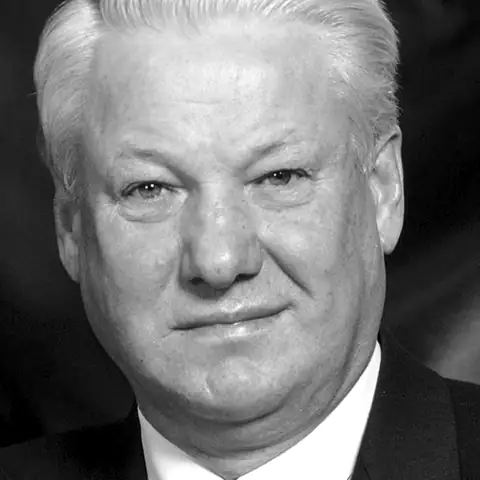
Who was Boris Yeltsin?
Boris Yeltsin grew up in a poor rural family in the Ural region and trained as a construction engineer. He climbed the Communist Party ranks in Sverdlovsk, and Mikhail Gorbachev moved him to Moscow in 1985. He fell out with the Soviet leadership, and he left the party in 1990. In 1991 Russians elected him president, and he resisted the hardline coup that August. That December he signed the agreement that broke up the USSR. He won a second term in 1996 despite poor health and stepped down on 31 December 1999, handing power to Vladimir Putin.
Political views
- Banned the Communist Party of Russia after the failed hardline coup of August 1991.Source: theguardian.com
- Freed prices in January 1992 as the start of a fast move to a market economy. Inflation that year ran to roughly 2,000 percent.Source: theguardian.com
- Ran voucher privatization from 1992, then the 1995 loans-for-shares auctions, which left major companies with a small group of owners.Source: en.wikipedia.org
- Dissolved the Supreme Soviet by decree in September 1993. A new constitution that gave the president far greater power won approval in December.Source: en.wikipedia.org
- Sent troops into Chechnya in December 1994 to crush its separatist government.Source: en.wikipedia.org
- Signed a 1992 declaration with George H. W. Bush that the Cold War was over, and preferred a Europe-wide security system to expanding NATO.Source: en.wikipedia.org
Legacy
Admirers say Yeltsin stopped the 1991 coup, ended communist rule in Russia without a civil war and allowed real elections. Critics stress what his rule cost ordinary people. The economy shrank sharply in the 1990s, millions fell into poverty, and privatization created a few very rich oligarchs before the 1998 default. They also point to the shelling of parliament in 1993, which left 147 dead by the official count, and to the First Chechen War, which killed tens of thousands of civilians. By the time he resigned, few Russians approved of him.