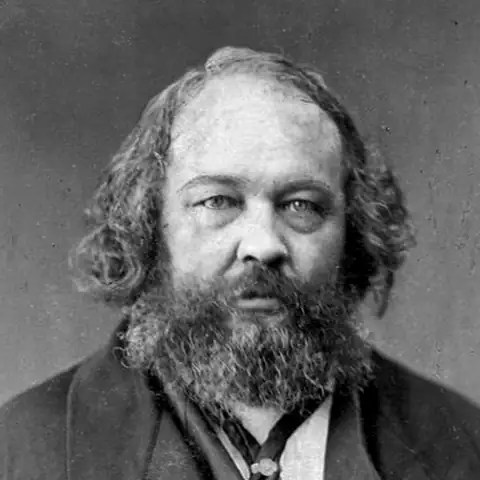
Who was Mikhail Bakunin?
The noble family of Mikhail Bakunin lived at Pryamukhino in the Russian Empire. He dropped a military career to study philosophy, in Moscow first and then in Berlin. He fought in the 1848-1849 revolutions, was arrested and imprisoned, and was sent to Siberia, escaping in 1861. Once in the West he became the chief voice of anti-authoritarian socialism in the International Workingmen's Association. A bitter quarrel with Marx ended in his expulsion at the 1872 Hague Congress. Two of his major texts are God and the State and Statism and Anarchy. Bakunin died in Bern.
Political views
- Insisted that a revolution should destroy the state, not capture it, because rule by a state always means domination.Source: plato.stanford.edu
- Predicted that a workers' state in the Marxist mould would be run by a new elite drawn from former workers and intellectuals.Source: marxists.org
- Held that freedom and socialism cannot be separated, and rejected liberal capitalism and authoritarian socialism alike.Source: marxists.org
- Called for land and the means of production to belong collectively to free associations of workers.Source: marxists.org
- Wanted a society of self-governing communes joined in a federation, organised from the base upward.Source: theanarchistlibrary.org
- Dismissed religion and divine authority as props for political domination.Source: plato.stanford.edu
Legacy
Bakunin inspired anarchist movements in Spain, Italy, Switzerland and Latin America. In Spain they included the anarchist trade unions that counted for so much in the 1930s. Anarchists and some historians say he foresaw how a revolutionary regime could harden into a bureaucratic ruling class, a charge later aimed at the Soviet Union. Marxists called him a conspirator who broke the International in two. Liberal and conservative critics point to his support for insurrection, and historians have found antisemitic passages in his attacks on Marx. He is still read by libertarian socialists. A line from an 1842 essay, that the urge to destroy is also a creative urge, is often quoted to capture his revolutionary temper.
In their own words
“Convinced that freedom without Socialism is privilege and injustice and that Socialism without freedom is slavery and brutality.”
“They will no longer represent the people, but only themselves and their claims to rulership over the people.”