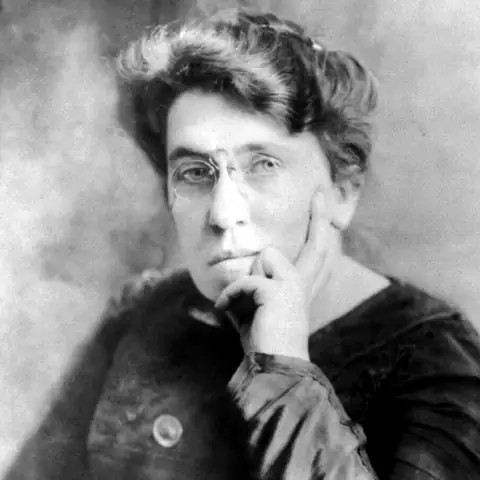
Who was Emma Goldman?
Emma Goldman left the Russian Empire for the United States as a teenager in 1885. She settled in the immigrant working class and was pushed toward anarchism by the execution of the Haymarket defendants. She toured the country as a speaker and spoke in English, German and Yiddish. Her magazine Mother Earth began in 1906. Police and courts jailed her many times. In 1917 she and Alexander Berkman got two years for urging resistance to the draft. In 1919 the United States deported her to Russia, where she turned against the Bolshevik state. She later backed the Spanish anarchists and died in Toronto in 1940.
Political views
- Described anarchism as a society built on liberty, in which government, resting on force, would no longer be needed.Source: gutenberg.org
- Believed that elections and party politics did little for workers, and that strikes and other direct action were more effective.Source: gutenberg.org
- Dismissed votes for women as a false hope that would not free anyone, and looked to other routes for women's liberation.Source: gutenberg.org
- Spoke up for sexual and reproductive freedom, and was arrested in 1916 for teaching people about birth control in public.Source: jwa.org
- Fought attempts to ban her talks, and her campaigns fed into the movement for free speech rights that later produced the ACLU.Source: jwa.org
- Opposed American entry into the First World War and the draft, and with Alexander Berkman formed the No-Conscription League.Source: en.wikipedia.org
- Cheered the Bolshevik revolution at first, then broke with the Soviet regime and wrote My Disillusionment in Russia in 1923.Source: en.wikipedia.org
Legacy
Admirers see Goldman as a trailblazer for free speech, contraception and sexual freedom, and as one of the first on the left to condemn Soviet tyranny. Her talks and essays on prisons, marriage and patriotism found huge audiences. Critics point to her links with political violence. She helped plan Berkman's 1892 attempt to kill the industrialist Henry Clay Frick, and in 1901 she defended Leon Czolgosz, who shot President McKinley, although nothing tied her to that crime. Fear of anarchist bombings turned the state against her, and J. Edgar Hoover pushed for her removal in 1919. Her scorn for the vote also put her at odds with suffragists.
In their own words
“The philosophy of a new social order based on liberty unrestricted by man-made law; the theory that all forms of government rest on violence, and are therefore wrong and harmful, as well as unnecessary.”