12axes-testTake the test
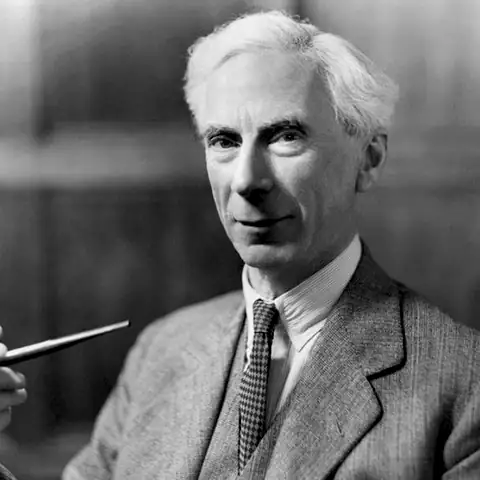
Bertrand Russell
Historical figureUnited Kingdom1872-1970

Bertrand Russell

Philosopher, logician and social critic · Founding president of the Campaign for Nuclear Disarmament

British philosopher and peace campaigner who opposed World War I, led the early fight against nuclear weapons, backed a world government and called religion a harmful force.

Profile on 12 axes10 of 12 documented
ECONOMYSTATESOCIETYWORLDOwnershipMarketsWelfareAuthoritySecurityStructureMoralityReligionTechnologyCultureTradeForeign
Where they stood

Bertrand Russell, axis by axis

  1. PublicPrivate

    He called himself a socialist and backed guild socialism, but turned against Bolshevism after his 1920 trip to Soviet Russia.

  2. PlannedFree
  3. SharedSelf-reliant
  4. DemocraticStrong leader
  5. LibertyOrder
  6. 06StructureNo clear record
    LocalCentral

    Guild socialism points to decentralized power, yet he also wanted a democratic world government, so the two pull apart. Left empty.

  7. ProgressiveTraditional
  8. SecularReligious
  9. EmbraceCaution

    He praised science and reason, but he fought nuclear arms as a danger to human survival. That puts him slightly toward caution.

  10. MulticulturalNational identity

    He headed the India League through the 1930s and opposed empire. In 1943 he also backed a Jewish state.

  11. 11TradeNo clear record
    GlobalProtected
  12. CooperationStrength

    He favored disarmament and world government. His 1948 comments on a possible war against the USSR, made while only America had the bomb, are disputed. In 1943 he gave up strict pacifism.

2 axes have no clear record, so matching leaves them out.

Who was Bertrand Russell?

Bertrand Russell was born in 1872 in Trellech, Wales, into an aristocratic Liberal family. He helped found analytic philosophy. He ran for Parliament as a supporter of votes for women in 1907, and for Labour in 1922 and 1923. He spoke out against the First World War, lost his post at Trinity College and was held in Brixton Prison for five months in 1918. He inherited an earl's title in 1931 and won the 1950 Nobel Prize for literature. In old age he became a figurehead of the anti-nuclear and anti-Vietnam War movements, and he died at his home in Wales in 1970.

Political views

  • His 1920 trip to Soviet Russia ended his sympathy for Bolshevism. Later he condemned Stalin's totalitarian rule.Source: en.wikipedia.org
  • He backed guild socialism, a system run by workers' guilds, and a democratic world government.Source: en.wikipedia.org
  • He opposed Britain's part in the First World War. In 1918 he went to prison over an article suggesting US troops could be used against British strikers.Source: plato.stanford.edu
  • He said organized religion is untrue and harmful to society. He also wanted children taught about sex and looser sexual rules.Source: plato.stanford.edu
  • In 1955 he put his name to the Russell-Einstein Manifesto on the danger of nuclear war. In 1958 he became founding president of CND, Britain's anti-nuclear group.Source: plato.stanford.edu
  • In 1961 he served a week in jail because he would not stop organizing a huge sit-down protest against nuclear weapons.Source: en.wikipedia.org
  • He spoke out against the Vietnam War and in 1966 set up an international tribunal to judge American conduct in it.Source: plato.stanford.edu

Legacy

Russell is remembered as a great logician and as one of the best known public rebels of his century. Admirers praise his bravery in standing against the 1914-18 war, his defence of free thought and his early leadership against nuclear arms. Critics call his political judgment uneven. They point to his backing of appeasement in the 1930s, his disputed 1948 remarks that seemed to favor a preventive war against Moscow, and his willingness to lend his name to campaigns that treated American policy harshly. In 1940 a court in New York blocked his job at City College, calling him morally unfit because of his writing on sex and marriage.

In their own words

“I am as firmly convinced that religions do harm as I am that they are untrue.”
Preface to Why I Am Not a Christian, 1957

How close are you to Bertrand Russell?

Take the 12 Axes test and see which historical figure is your political twin, axis by axis.

Take the test

Bertrand Russell: questions

Was Bertrand Russell an atheist?

He is often called as an atheist in practice, though he sometimes called himself an agnostic. Either way, he argued openly that organized religion is untrue and does harm.

What kind of socialist was Bertrand Russell?

He called himself one, but not a Marxist. He backed guild socialism and ran for Labour. He rejected Bolshevism after seeing Soviet Russia in 1920.

Why was Bertrand Russell sent to prison?

In 1918 he went to prison over an article that attacked the war and hinted that US soldiers could be turned on strikers. In 1961 he was jailed again, for a week, over an anti-nuclear protest.

Sources