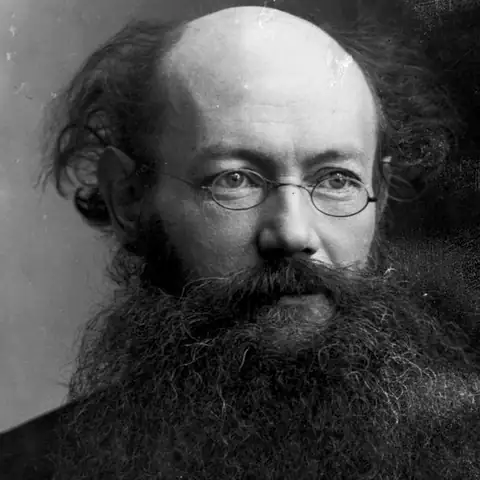
Who was Peter Kropotkin?
Peter Kropotkin was born in Moscow into an old noble family. As an army officer in Siberia he did geographical survey work that won him respect as a scientist. In the 1870s he gave up his title and joined the revolutionary movement. Russian authorities jailed him, but he escaped in 1876, and a French court later sent him to prison too. He then lived in England for about thirty years. He wrote The Conquest of Bread, Fields, Factories and Workshops and Mutual Aid. After going home in 1917 he criticised the methods of the Bolshevik government. He died in the town of Dmitrov in 1921. He is the best-known voice of anarchism that wants common ownership.
Political views
- Argued that nature shows cooperation inside species to be as much a law of life as competition, which challenged the social Darwinist view of evolution.Source: theanarchistlibrary.org
- Put forward anarchist communism, in which land and tools belong to everyone and goods are handed out according to need.Source: theanarchistlibrary.org
- Predicted that once private ownership of the means of production ended, wages would disappear too.Source: theanarchistlibrary.org
- Called for industry to be spread across local communities, mixing farming with manufacturing and manual work with study.Source: theanarchistlibrary.org
- Rejected every kind of state, even a revolutionary one, and wanted a federation of free communes instead.Source: plato.stanford.edu
- Broke with most anarchists in 1916 by signing the Manifesto of the Sixteen in favour of the Allied side in the First World War.Source: en.wikipedia.org
Legacy
Kropotkin is among the most widely read anarchist authors. His thinking shaped anarchist movements in Spain, Latin America and East Asia, and it later fed into debates about cooperatives, ecology and city planning. Scientists who study how cooperation evolves still discuss Mutual Aid. Marxists called his plan utopian. Soon after his death the Bolshevik state he had criticised crushed anarchist groups, and his Moscow funeral was among the last big anarchist gatherings it allowed. Liberals and free-market thinkers ask how a large economy could share out goods with no prices and no state. Many anarchists, Errico Malatesta among them, condemned his backing for the Allies in 1916 as a betrayal of antimilitarism.
In their own words
“Well-being for all is not a dream. It is possible, realizable, owing to all that our ancestors have done to increase our powers of production.”
“Sociability is as much a law of nature as mutual struggle.”