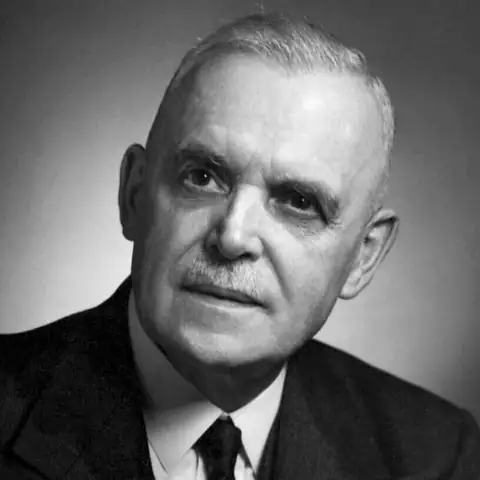
Who was Louis St. Laurent?
Louis St. Laurent was born in 1882 in Compton, Quebec. His father was French-Canadian and his mother Irish-Canadian, and he became a leading Quebec lawyer. Mackenzie King pulled him into politics in 1941 as minister of justice and as his man in Quebec. St. Laurent moved to External Affairs in 1946 and, in 1948, succeeded King at the head of the Liberals and of the government. People called him 'Uncle Louis'. He won large majorities in 1949 and 1953, then lost to John Diefenbaker in 1957, and he died in 1973.
Political views
- Was one of the first senior politicians to float the idea of a North Atlantic pact, and Canada signed on as a NATO member in 1949.Source: biographi.ca
- From 1947 he described a deep gulf between the West and 'totalitarian communism', and he sent troops, ships and aircraft to fight under the UN in Korea.Source: biographi.ca
- In 1949 he chose not to ban the Communist Party of Canada, saying it was a small danger and a ban too harsh.Source: en.wikipedia.org
- Brought in equalization payments for poorer provinces and a hospital insurance plan, a first step toward public medicare.Source: en.wikipedia.org
- Stopped legal appeals to London's Privy Council, so the Supreme Court of Canada became the last word.Source: en.wikipedia.org
- The 1952 Immigration Act, passed under him, let officials refuse entry on grounds of nationality, ethnicity or 'probable inability to assimilate'.Source: pier21.ca
- Joined with the Americans to build the St. Lawrence Seaway, and also backed a cross-country highway and gas pipeline.Source: biographi.ca
Legacy
His admirers remember a calm leader of a prosperous decade who firmed up the welfare state, cut the wartime debt, absorbed Newfoundland and gave the country a busy role at NATO and the UN. Equalization is often said to have strengthened the federation. Many critics argued then and later that long Liberal rule had made the government proud and deaf, a charge that stuck when ministers used closure to ram the 1956 pipeline bill through the Commons. Westerners felt ignored. His government also approved the 1953 High Arctic move that forced 92 Inuit north, and the 1952 immigration law kept biased selection powers until the 1960s.