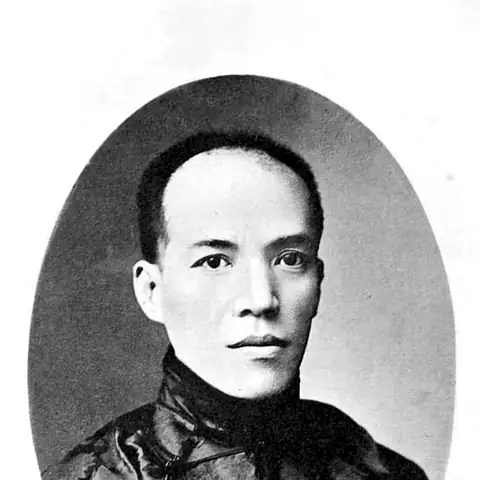
Who was Liang Qichao?
Liang was born in 1873 in Xinhui, in Guangdong. He studied under Kang Youwei and worked with him on the 1898 Hundred Days' Reform. When Empress Dowager Cixi ended the reforms in September 1898, Liang fled to Japan, where he lived in exile for 14 years. There he edited the biweekly New Citizen from 1902 and argued for constitutional monarchy and a renewed Chinese people. He returned to China in 1912 after the Republic was set up and formed the Progressive Party. He served as Minister of Justice under Yuan Shikai from 1913 to 1914, then opposed Yuan's 1915 plan to become emperor. He left politics after 1917 and died in 1929.
Political views
- In 1898 he and his mentor Kang Youwei pushed the Hundred Days' Reform, which aimed to turn the Qing dynasty into a constitutional monarchy.Source: chinabooksreview.com
- Empress Dowager Cixi took over in September 1898, put the emperor under house arrest and ordered the reformers executed. Liang escaped to Japan.Source: newworldencyclopedia.org
- In 1899 he and Kang founded the Society to Protect the Emperor, which promoted constitutional monarchy among overseas Chinese.Source: newworldencyclopedia.org
- He preached reform while Sun Yat-sen promoted revolution. They cooperated several times, but Sun's militancy and Liang's moderation blocked a lasting partnership.Source: chinabooksreview.com
- His journal New Citizen began in Yokohama on 8 February 1902 and ran for 96 issues until 1907. Its readership is estimated at 200,000.Source: newworldencyclopedia.org
- His 1902 essay on renewing the people argued that China needed nationalism, which required educating its people. His arguments drew on Social Darwinism.Source: chinabooksreview.com
- After the Republic began he merged his Democratic Party with the Republicans to form the Progressive Party. He first sided with Yuan Shikai, served as Minister of Justice from September 1913 to February 1914, then opposed Yuan's 1915 bid to become emperor.Source: newworldencyclopedia.org
- He served briefly as Minister of Finance under Duan Qirui in 1917, criticized Kang's backing of the failed July 1917 Qing restoration, and then turned back to academic work.Source: chinabooksreview.com
Legacy
Liang is remembered as one of the most influential Chinese writers of his era. Admirers credit him with bringing Western and Japanese political ideas to a wide audience and helping shape modern Chinese journalism and nationalism. Critics note that his gradual path of constitutional monarchy was overtaken by the revolutionary change that he had opposed. One scholar says he was more at home with political thought than political action, and that his ties to failed uprisings, rather than a successful revolution, leave his reputation behind Sun Yat-sen's. His early cooperation with Yuan Shikai also drew criticism before he turned against him.