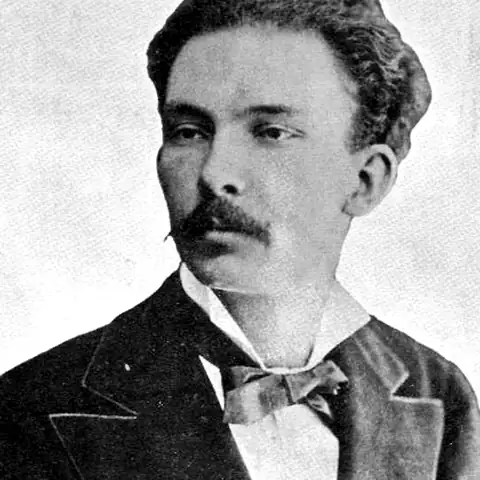
Who was José Martí?
José Martí was born in Havana in 1853 to parents who had come from Spain. As a teenager he took the side of rebels in the Ten Years' War. For that he was put to hard labor, then banished to Spain, where he studied law. He then lived in Mexico, Guatemala and Venezuela before settling in New York in 1881. He filed articles for papers throughout Spanish America, and in 1891 he issued the poems of Versos sencillos. In 1892 he started the Cuban Revolutionary Party to prepare a new war against Spain. He came ashore in Cuba in April 1895. A month later, on 19 May, he died in a clash at Dos Ríos.
Political views
- He rejected the idea of a racial ladder. His words were that there is no race hatred, because there are no races.Source: es.wikisource.org
- He called for a war without hatred of Spaniards and without fear between races, and he asked Black and white Cubans to stand together.Source: es.wikisource.org
- He wanted the independence war to be brief and run in a republican way, so that it would not produce a military dictatorship.Source: guides.loc.gov
- He pictured a republic of all classes and races, with votes for everyone and a fairer spread of land.Source: en.wikipedia.org
- He argued that each Latin American country should build its government from its own conditions, not copy models from Europe or North America.Source: es.wikisource.org
- He admired the energy of the United States and its founders, but he condemned its imperial attitude toward the countries to its south.Source: guides.loc.gov
- He saw Cuban freedom as a barrier that would stop the United States from spreading over the Caribbean islands and the rest of Latin America.Source: es.wikisource.org
Legacy
Cubans honor Martí as 'El Apóstol', and very different camps claim him. The Cuban government calls him the thinker behind its revolution. Exiles and opponents of that government honor him as a champion of freedom and democracy. Some scholars read his work as socialist, others as liberal. He sided with workers, they note, yet he criticized Marx. He is also seen as one of the founders of Spanish American modernismo, a literary movement, and lines of his verse became the song 'Guantanamera'. Critics of the Cuban state say it ignores his steady hostility to dictatorship. Its defenders stress his opposition to imperialism.
In their own words
“Let the world be grafted onto our republics; but the trunk must be that of our republics.”
“I lived in the monster, and I know its entrails.”