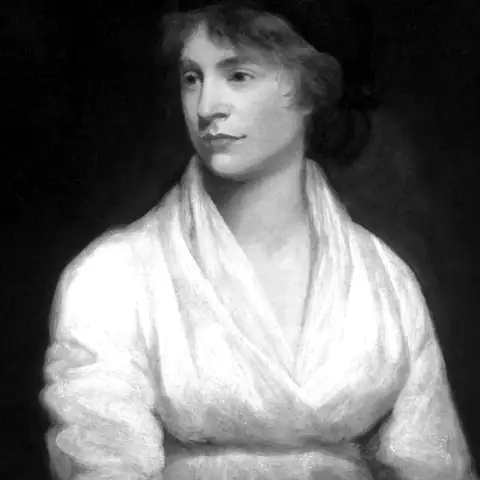
Who was Mary Wollstonecraft?
Mary Wollstonecraft was born in London in 1759. She earned her living as a lady's companion, a teacher and a governess, and she later joined the circle around the publisher Joseph Johnson. The Dissenting minister Richard Price influenced her. Her first big work, from 1790, answered Edmund Burke, who had attacked the French Revolution; she called it A Vindication of the Rights of Men. Two years later came the book on women for which she is best known. She lived in Paris for part of the Revolution. In 1797 she wed the philosopher William Godwin, and she died that September, days after giving birth to the future Mary Shelley.
Political views
- Said that women seem weaker in mind because of the schooling and expectations placed on them, and not because nature made them less able to reason.Source: plato.stanford.edu
- Pushed back against Rousseau's idea that girls should be raised mainly to please men.Source: gutenberg.org
- Wanted public day schools where boys and girls would learn together.Source: gutenberg.org
- Held that women should be able to train in fields such as medicine and to earn a living in business, so that they could support themselves.Source: gutenberg.org
- Said women should have representatives in government and not be ruled without a voice.Source: gutenberg.org
- Wrote that for most women marriage worked as a property arrangement that left a wife dependent on her husband.Source: plato.stanford.edu
- Defended the Revolution's principles in reply to Burke, and condemned inherited rank and privilege.Source: plato.stanford.edu
Legacy
Many regard Wollstonecraft as a founder of modern feminism, and later campaigners for women's rights and education built on her writing. Godwin's frank memoir of her life damaged her name for most of the nineteenth century, and opponents used her private story to dismiss her arguments. Modern scholars describe her in several ways: liberal, republican, moral philosopher. Amartya Sen has noted her appeal for social justice. During her lifetime she found little support among other intellectuals, and the poet Anna Barbauld, for one, did not share her views on women.
In their own words
“I do not wish them to have power over men; but over themselves.”