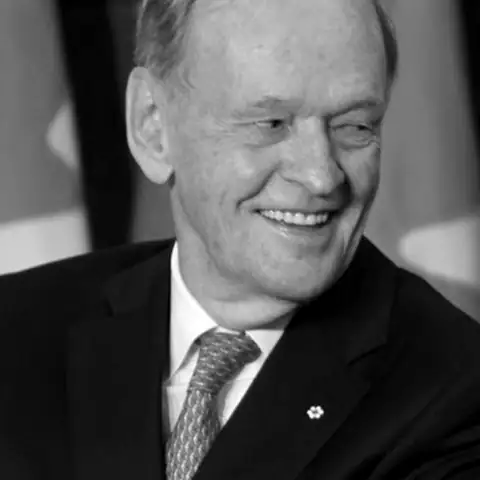
Who is Jean Chrétien?
Chrétien grew up in Shawinigan Falls, Quebec, where he was born in 1934, and studied law at Laval. Voters first sent him to Ottawa in 1963. Later, in cabinets led by Pearson and Trudeau, he held senior jobs, running Indian affairs, finance and justice. As justice minister he helped bring the constitution home in 1982. He took the Liberal leadership in 1990 and won majorities in three elections in a row, starting in 1993. His time as leader ended in 2003, and he has not held office since.
Political views
- As minister for Indian affairs he issued the 1969 White Paper, which aimed to abolish the Indian Act and treaty status. First Nations objected and Ottawa backed down.Source: en.wikipedia.org
- Led a government of hard budget cuts that produced, in 1997, the first federal surplus in almost three decades.Source: en.wikipedia.org
- His 2000 Clarity Act says Parliament will negotiate with a province over leaving only after a clear question wins a clear majority.Source: laws-lois.justice.gc.ca
- Declined to take Canada into the US-led attack on Iraq in 2003, citing the lack of UN backing.Source: theglobeandmail.com
- His government brought in a firearms registry in 1995 and sold Canadian National Railway to private owners.Source: en.wikipedia.org
- Signed the Kyoto climate accord and drove the treaty to ban anti-personnel mines signed in Ottawa.Source: en.wikipedia.org
- Tabled a 2003 bill recognizing same-sex marriage after Ontario's courts overturned the traditional definition.Source: en.wikipedia.org
Legacy
Supporters say Chrétien repaired federal finances, kept Canada intact after the 1995 scare and made a principled choice on Iraq. His plain-spoken image as a scrapper from a small town helped deliver three majority wins. Critics say his budget cuts left provinces short of money for health and social programs. They also point to the sponsorship program, intended to promote federalism in Quebec, where millions were misused. The Gomery inquiry assigned him some blame, but in 2008 the Federal Court set that finding aside, citing apparent bias. Indigenous leaders still object to the 1969 White Paper. An inquiry into the 1997 APEC summit found his office wrongly pressed the RCMP, but cleared him personally.