12axes-testTake the test
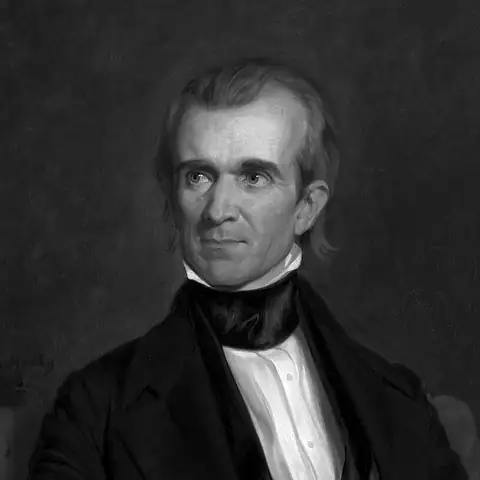
James K. Polk
Historical figureUnited States1795-1849

James K. Polk

11th President of the United States (1845-1849) · Speaker of the U.S. House of Representatives

Democratic president from Tennessee who lowered tariffs, revived the Independent Treasury, settled Oregon with Britain and won a war with Mexico that gave the US California and the Southwest.

Profile on 12 axes7 of 12 documented
ECONOMYSTATESOCIETYWORLDOwnershipMarketsWelfareAuthoritySecurityStructureMoralityReligionTechnologyCultureTradeForeign
Where they stood

James K. Polk, axis by axis

  1. PublicPrivate

    No debate over public ownership existed in his day. The score comes from his Jacksonian belief in a private economy without federal privileges.

  2. PlannedFree

    He fought a national bank and revived the Independent Treasury so federal money stayed away from private banks.

  3. SharedSelf-reliant

    He refused the Whig plan to pay for roads and canals from federal funds. In his day there was no welfare system.

  4. DemocraticStrong leader

    He kept close control over his cabinet and over war policy, and he sent troops into disputed ground before Congress declared war. On domestic issues he worked through Congress.

  5. 05SecurityNo clear record
    LibertyOrder

    The sources used here record no stance on civil liberties or policing, so this is left empty.

  6. LocalCentral

    His platform opposed federal spending on internal improvements and any federal interference with slavery inside the states.

  7. 07MoralityNo clear record
    ProgressiveTraditional

    Nothing is known about his views on family or social life apart from the usual ideas of his day, so this is left empty.

  8. 08ReligionNo clear record
    SecularReligious

    The sources used here do not cover religion and public life, so this is left empty.

  9. 09TechnologyNo clear record
    EmbraceCaution

    No known view, and the question hardly fits his century.

  10. 10CultureNo clear record
    MulticulturalNational identity

    The sources used here record no stance on immigration, so this is left empty.

  11. GlobalProtected

    The Walker Tariff of 1846 lowered rates, and he approved it.

  12. CooperationStrength

    No other president of his century expanded the country as much. He pushed into a war with Mexico and won it, gaining the Southwest and California, yet he made a deal with Britain over Oregon.

5 axes have no clear record, so matching leaves them out.

Who was James K. Polk?

Polk was a lawyer and plantation owner in Tennessee who held enslaved people. He was a faithful ally of Andrew Jackson and rose to be Speaker of the House and then governor of his state. In 1844 he was a surprise Democratic nominee. He won the White House on a promise of westward growth and said he would serve only one term. He listed four aims: a lower tariff, an independent treasury, a deal on Oregon and the acquisition of California. He reached all four. After Texas joined the Union, he sent soldiers into land that Texas and Mexico both claimed. The war that followed gave the US California and most of the modern Southwest.

Political views

  • In 1844 he ran against the Whig package of a national bank, steep duties and federal spending on roads and canals. He also pledged to serve just one term.Source: millercenter.org
  • He signed the 1846 Walker Tariff, which brought duties down to levels meant only to raise revenue.Source: millercenter.org
  • In 1846 he brought back the Independent Treasury, so the government held its own money instead of using private banks.Source: millercenter.org
  • In the Oregon dispute he accepted a line with Britain along the 49th parallel, though some of his backers wanted more land.Source: millercenter.org
  • Ahead of the 1846 war, he moved soldiers into contested land by the Rio Grande and tried to buy California.Source: millercenter.org
  • He opposed the Wilmot Proviso, which would have banned slavery in land taken from Mexico. He would rather have carried the old Missouri Compromise line of 36 degrees 30 minutes west to the Pacific.Source: millercenter.org

Legacy

Many historians place Polk among the stronger presidents. He chose clear goals, achieved them and ran the executive branch with discipline. His term added about a third to the country's size. Admirers of expansion saw him as carrying out Manifest Destiny. Critics, in his own day and since, call the Mexican War a land grab. A young congressman, Abraham Lincoln, demanded to know the exact place where US blood was shed. Mexico, for its part, lost around half its land. Arguments over slavery in the new territory made the split between North and South worse and led toward the Civil War. Polk also held slaves for all of his adult life.

How close are you to James K. Polk?

Take the 12 Axes test and see which historical figure is your political twin, axis by axis.

Take the test

James K. Polk: questions

Was James K. Polk a Democrat?

Yes. He was a Democrat, and his closeness to Andrew Jackson won him the nickname Young Hickory.

Did Polk cause the Mexican-American War?

Polk put soldiers on ground that Texas and Mexico both claimed. After fighting broke out there, Congress voted for war in 1846. Critics say he provoked the fight to get California and the Southwest. Supporters say Mexico started it by attacking US soldiers.

Did Polk serve only one term?

Yes, as he had promised. He stayed out of the 1848 race. Cholera killed him about three months after he left office.

Sources