12axes-testTake the test
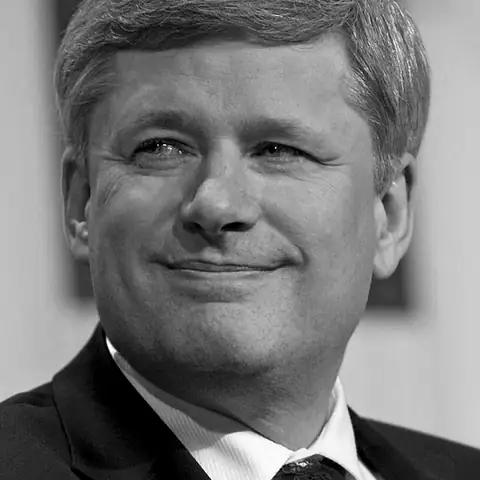
Stephen Harper
Retired figureCanadaBorn 1959

Stephen Harper

22nd Prime Minister of Canada (2006-2015) · Leader of the Conservative Party of Canada (2004-2015)

Calgary-trained economist and former Conservative prime minister of Canada, whose government cut taxes, scrapped the long-gun registry, left Kyoto, struck trade deals and apologized for residential schools.

Profile on 12 axes11 of 12 documented
ECONOMYSTATESOCIETYWORLDOwnershipMarketsWelfareAuthoritySecurityStructureMoralityReligionTechnologyCultureTradeForeign
Where they stand

Stephen Harper, axis by axis

  1. PublicPrivate
  2. PlannedFree
  3. SharedSelf-reliant
  4. DemocraticStrong leader

    He suspended Parliament in 2008 to head off a confidence vote and did so again in 2009. In 2011 his government became the first found in contempt of Parliament, so the score leans toward executive power.

  5. LibertyOrder

    His Anti-terrorism Act, 2015 gave security agencies wider powers, but he scrapped the long-gun registry, citing liberty, so the score leans toward order.

  6. LocalCentral

    He put his name to the firewall letter, which urged Alberta to protect itself from federal redistribution, and he called the Québécois a nation within Canada, so the score leans local.

  7. ProgressiveTraditional

    He was against same-sex marriage and against extending benefits to same-sex couples, though he kept abortion out of his party's platform, so the score is moderately traditional.

  8. SecularReligious

    An evangelical Christian, he largely left religion out of government policy, so the score leans only a little toward a religious role.

  9. 09TechnologyNo clear record
    EmbraceCaution

    No steady record on technology regulation, so this is null.

  10. MulticulturalNational identity
  11. GlobalProtected
  12. CooperationStrength

One axis has no clear record, so matching leaves it out.

Who is Stephen Harper?

Born in 1959 in Toronto, in the Leaside neighbourhood, Stephen Harper later moved to Alberta and earned his economics degrees at Calgary. He helped found the Reform Party, won a seat in Parliament in 1993 and held it until 1997. He then ran the National Citizens Coalition, an advocacy group. As Canadian Alliance leader from 2002, he arranged the 2003 merger with the Progressive Conservatives. He became leader of the merged party in 2004. He held the prime minister's office for nine years, from 2006 to 2015, and quit Parliament in 2016. Today he chairs the International Democracy Union, a group of centre-right parties, and has chaired the Alberta Investment Management Corporation since 2024. He holds no elected office.

Political views

  • His government lowered the GST from 7 per cent to 5 and trimmed corporate taxes.Source: en.wikipedia.org
  • In 2006 he moved a motion in the House calling the Québécois a nation inside a united Canada, while ruling out independence for Quebec.Source: cbc.ca
  • In 2008, as prime minister, he apologized for the government. The residential school system had taken over 150,000 Indigenous children away from their homes.Source: rcaanc-cirnac.gc.ca
  • In 2012 his government abolished the long-gun registry. He accepted that it had encouraged the RCMP to destroy the registry's records.Source: cbc.ca
  • Canada pulled out of the Kyoto Protocol in 2011 while he was in office.Source: en.wikipedia.org
  • His government signed many free trade agreements and began the Global Markets Action Plan, aimed at lifting exports.Source: en.wikipedia.org
  • In his 2014 speech to the Knesset, he promised that Canada would be with Israel through fire and water.Source: cbc.ca

Legacy

Admirers say Harper united Canada's right and steered the country through the 2008 recession, after which The Economist judged it stronger than any other G7 economy. They also point to lower taxes, more trade, and strong positions against Russia's aggression and in support of Israel. Critics say he gathered too much power in his own office and weakened Parliament. They point out that he prorogued it in both 2008 and 2009 and that in 2011 his government was the first held in contempt of Parliament. Scientists opposed research cuts, statisticians the scrapping of the compulsory long-form census, and environmentalists the exit from Kyoto. His government was also hit by the robocall and Senate expenses scandals.

In their own words

“And therefore, through fire and water, Canada will stand with you.”
Speech to the Israeli Knesset, 2014

How close are you to Stephen Harper?

Take the 12 Axes test and see which historical figure is your political twin, axis by axis.

Take the test

Stephen Harper: questions

Which party does Stephen Harper belong to?

He is a Conservative. He took part in creating today's Conservative Party in 2003, and he was its leader until 2015. Earlier he was a Reform Party MP and the leader of the Canadian Alliance.

Is Stephen Harper still in politics?

He holds no elected office. His roles are chairing the International Democracy Union, which links centre-right parties around the world, and heading the Alberta Investment Management Corporation, a post he took in 2024.

Why did Harper apologize in 2008?

As prime minister he apologized for the government's part in the residential school system. It had taken more than 150,000 Indigenous children from their homes.

Sources

Portrait: Stephen Harper by Remy Steinegger Infobox.jpg by World Economic Forum / Remy Steinegger, CC BY-SA 2.0, via Wikimedia Commons. Cropped and converted to grayscale by 12axes-test.com.