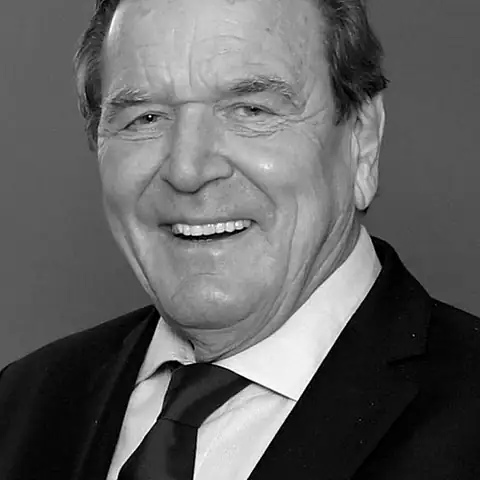
Who is Gerhard Schröder?
Gerhard Schröder grew up poor in Lippe. He earned his school certificates at night classes and set up as a Hanover lawyer. He headed the SPD's youth wing, won a Bundestag seat in 1980 and ran the state government of Lower Saxony from 1990. Defeating Helmut Kohl in 1998, he governed alongside the Greens, whose Joschka Fischer became foreign minister. Once his Bundesrat majority was gone, he asked for an early election in 2005 and Angela Merkel succeeded him. He now holds no office. A party panel ruled in 2023 that he could stay in the SPD.
Political views
- In 2003 he launched Agenda 2010, a set of reforms to the welfare system and the job market.Source: hdg.de
- His first government decided to end nuclear power over time, set up civil partnerships for gay and lesbian couples, and loosened the rules on gaining German citizenship.Source: hdg.de
- In 1999 he sent German forces into NATO's air war over Kosovo. It was their first combat mission since World War II.Source: hdg.de
- In 2001 he linked a vote of confidence to sending the Bundeswehr to Afghanistan.Source: en.wikipedia.org
- In 2002 he announced that Germany would stay out of any military action against Iraq.Source: hdg.de
- In 2000 he suggested bringing foreign high-tech workers to Germany.Source: hdg.de
- He formed a close bond with Vladimir Putin and backed the Nord Stream gas link between Russia and Germany.Source: en.wikipedia.org
Legacy
Supporters say Schröder modernized his party and moved it to the centre. They credit Agenda 2010 with reshaping a costly welfare system, and many Germans welcomed his decision to stay out of Iraq. Critics on the left say the reforms cut support for jobless people and split the SPD. His work after politics is the biggest controversy. Within weeks of leaving office he chaired the shareholders' committee of Nord Stream AG, the pipeline company his government had supported. Later he chaired the board of Russia's state oil firm Rosneft. When Russia invaded Ukraine in 2022, he quit Rosneft and passed on a seat at Gazprom, yet he never cut ties with Putin. The Bundestag stopped paying for his ex-chancellor's office.