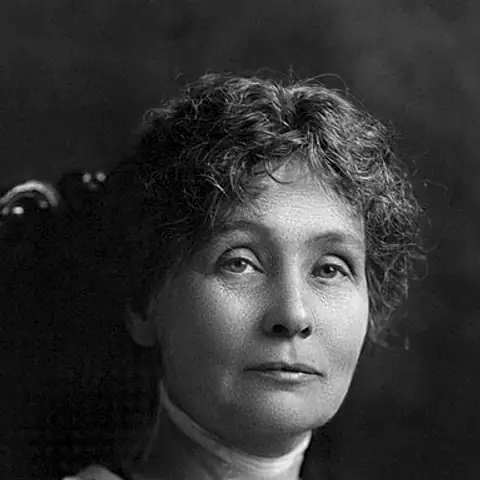
Who was Emmeline Pankhurst?
Emmeline Pankhurst was born Emmeline Goulden in Manchester in 1858, into a family with radical views. She went to her first suffrage meeting as a teenager. In 1879 she married Richard Pankhurst, a barrister who had drafted an early bill for women's votes. In 1889 she co-founded the Women's Franchise League, and she also joined the Independent Labour Party. Her time as a Poor Law Guardian showed her how women suffered in the workhouse. In 1903 she started the WSPU, the Women's Social and Political Union, under the slogan "Deeds, not words". She was jailed many times between 1908 and 1914. When war began she called off the campaign and backed the war effort. Women over 30 won the vote in 1918. She died in 1928.
Political views
- Believed that polite speeches would never win the vote, and that women should work independently of every party.Source: en.wikipedia.org
- Pushed the union beyond petitions and parades to heckling ministers, smashing windows and starting fires.Source: londonmuseum.org.uk
- Went to prison for urging an attack on David Lloyd George's house, and went on hunger strike behind bars.Source: londonmuseum.org.uk
- Told a Hartford, Connecticut audience in 1913 that the suffrage struggle was a kind of civil war fought by women.Source: theguardian.com
- Ended the militant campaign in 1914 and held meetings and marches to rally women behind the war.Source: bbc.co.uk
- Joined the Conservatives in the 1920s, saying she feared Bolshevism, and was chosen as a parliamentary candidate.Source: en.wikipedia.org
Legacy
Many see Pankhurst as the central figure of the British suffrage fight. A statue of her sits beside the Houses of Parliament. Supporters say her campaign made it impossible to ignore the demand for women's votes. Critics then and since say that arson and similar tactics pushed away possible allies and may have slowed reform. They also say she ran the WSPU like an autocrat. Her daughters Sylvia and Adela fell out with her over tactics and over the war. Most historians agree the WSPU made the cause visible in ways that mattered.
In their own words
“I am here as a soldier who has temporarily left the field of battle in order to explain - it seems strange it should have to be explained - what civil war is like when civil war is waged by women.”