12axes-testTake the test
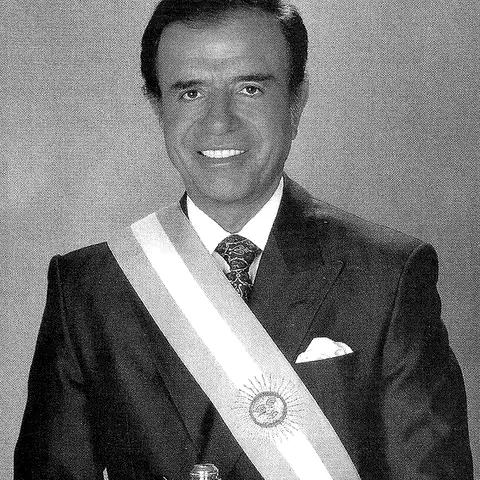
Carlos Menem
Historical figureArgentina1930-2021

Carlos Menem

President of Argentina (1989-1999) · Governor of La Rioja

Argentine president for a decade who turned Peronism toward markets, pegging the peso to the dollar and privatizing state firms, while pardoning the juntas' leaders.

Profile on 12 axes6 of 12 documented
ECONOMYSTATESOCIETYWORLDOwnershipMarketsWelfareAuthoritySecurityStructureMoralityReligionTechnologyCultureTradeForeign
Where they stood

Carlos Menem, axis by axis

  1. PublicPrivate

    He privatized more than 400 state companies, including the oil firm YPF, the telephone monopoly and the national airline. This is far from the Peronist tradition he inherited.

  2. PlannedFree
  3. SharedSelf-reliant
  4. DemocraticStrong leader

    He pardoned dictatorship leaders and pushed through the 1994 reform that let him run again, but he also left office after losing a bid for a third term in 1999. Mildly toward strong leadership.

  5. 05SecurityNo clear record
    LibertyOrder
  6. 06StructureNo clear record
    LocalCentral
  7. 07MoralityNo clear record
    ProgressiveTraditional
  8. 08ReligionNo clear record
    SecularReligious
  9. 09TechnologyNo clear record
    EmbraceCaution
  10. 10CultureNo clear record
    MulticulturalNational identity
  11. GlobalProtected

    He signed the Mercosur treaty in 1991 and opened the economy. Mercosur kept tariff exceptions, so the score is only moderately global.

  12. CooperationStrength

    He aligned Argentina closely with the United States and restored ties with Britain, which points to cooperation. His 'carnal relations' phrase suggests deference more than independence.

6 axes have no clear record, so matching leaves them out.

Who was Carlos Menem?

Carlos Menem, born in La Rioja to Syrian immigrant parents, studied law in Cordoba and rose through Peronist politics as a provincial governor. He won the 1988 party primary and the 1989 presidential vote, taking office early during hyperinflation. His campaign sounded populist, yet in government he dismantled much of the state economy. He signed pardons for former military rulers, reformed the constitution in 1994 to win a second term in 1995 and lost his bid for a third in 1999. He died in 2021.

Political views

  • Privatized more than 400 public companies, among them YPF, the telephone company Entel and Aerolineas Argentinas, and moved pension services into private hands.Source: cidob.org
  • Launched the Convertibility Plan in 1991, which fixed the peso at parity with the dollar and barred issuing money not backed by reserves.Source: cidob.org
  • Pardoned Videla, Viola, Galtieri and others in October 1989 and December 1990, the second time soon after a failed carapintada military revolt.Source: cidob.org
  • Signed the Treaty of Asuncion creating Mercosur in 1991, and in 1998 Argentina became a major non-NATO ally of the United States.Source: cidob.org
  • Agreed the Pact of Olivos with Raul Alfonsin, allowing one consecutive re-election, then saw a push for a third term rejected in the Chamber of Deputies in 1999.Source: cidob.org
  • Liberalized labor law, which unions protested in 1996 as unemployment stood near its 1995 peak of 18.4 percent.Source: cidob.org
  • Presided over market reforms that the IMF reviewed as an inflation fix: monthly inflation fell from about 27 percent in early 1991 to single digits by 1993.Source: imf.org

Legacy

Admirers credit Menem with ending hyperinflation and with growth of nearly 6 percent a year in 1991-98, according to the IMF. Critics say the sell-offs were careless, that unemployment and poverty climbed, and that the pardons of men responsible for the dictatorship's crimes shielded perpetrators of torture and disappearances. His family and circle faced money-laundering and arms-trafficking allegations. A Supreme Court ruling in 2001 found no basis for the arms charge.

How close are you to Carlos Menem?

Take the 12 Axes test and see which historical figure is your political twin, axis by axis.

Take the test

Carlos Menem: questions

Was Carlos Menem a Peronist?

Yes. He led the Peronist (Justicialist) Party and won the presidency under its banner in 1989. But he abandoned its older state-led economics for privatization and a peso pegged to the dollar.

What was the Convertibility Plan?

A 1991 law that fixed the Argentine peso at one to one with the US dollar and barred printing money without matching reserves. It stopped hyperinflation but tied the economy to the dollar.

Why did Menem pardon the military leaders?

He signed pardons in 1989 and 1990 for convicted dictatorship leaders. Critics saw impunity for serious human rights abuses, and the decision remains deeply divisive in Argentina.

Sources

Portrait: Menem con banda presidencial.jpg by Víctor Bugge, CC BY 2.0, via Wikimedia Commons. Cropped and converted to grayscale by 12axes-test.com.