12axes-testTake the test
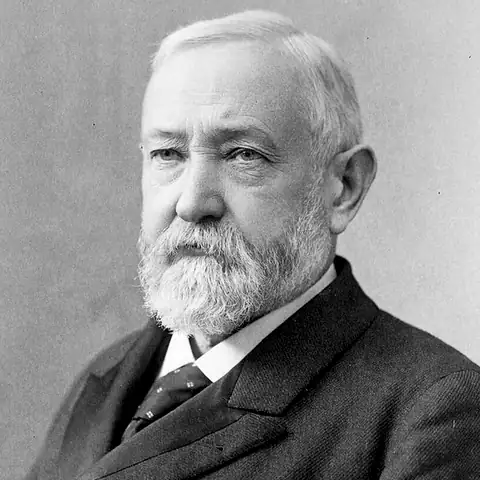
Benjamin Harrison
Historical figureUnited States1833-1901

Benjamin Harrison

23rd President of the United States (1889-1893) · U.S. Senator from Indiana

Harrison, grandson of a president, led the US from 1889 to 1893. His term brought high tariffs, the first antitrust law, bigger veteran pensions and a failed push to protect Black voters.

Profile on 12 axes7 of 12 documented
ECONOMYSTATESOCIETYWORLDOwnershipMarketsWelfareAuthoritySecurityStructureMoralityReligionTechnologyCultureTradeForeign
Where they stood

Benjamin Harrison, axis by axis

  1. PublicPrivate

    Ownership was not a live debate in his day. The score comes from his Republican backing of private industry behind tariff walls.

  2. PlannedFree

    He signed the Sherman Antitrust Act, the first federal law aimed at monopolies, and the Silver Purchase Act. That gives a small lean toward regulation.

  3. SharedSelf-reliant

    He championed the 1890 pension law, which greatly widened federal payments to Union veterans and their families.

  4. DemocraticStrong leader

    He supported a bill to protect Black voting rights in the South, though it died in the Senate. That puts him on the democratic side.

  5. 05SecurityNo clear record
    LibertyOrder

    The sources used here show no position on civil liberties or policing, so this axis is left empty.

  6. LocalCentral

    He backed federal oversight of congressional elections as a guard against state laws that kept Black citizens from voting.

  7. 07MoralityNo clear record
    ProgressiveTraditional

    Apart from the norms of his time, no position on family or social life is documented, so this axis is left empty.

  8. 08ReligionNo clear record
    SecularReligious

    The sources used here show no stance on religion in public life, so this axis is left empty.

  9. 09TechnologyNo clear record
    EmbraceCaution

    No view on technology is documented, so this axis is left empty.

  10. 10CultureNo clear record
    MulticulturalNational identity

    His record is mixed. He defended civil rights for Black Americans while his government kept Chinese exclusion in force, so this axis is left empty.

  11. GlobalProtected

    He signed the 1890 McKinley Tariff, which set very high protective rates.

  12. CooperationStrength

    He built up the navy, confronted Chile in the 1891 crisis and sent a Hawaii annexation treaty to the Senate after the queen was overthrown.

5 axes have no clear record, so matching leaves them out.

Who was Benjamin Harrison?

Benjamin Harrison, born in 1833, was the grandson of President William Henry Harrison. He practiced law in Indianapolis, led Union troops in the Civil War and later spent one term in the Senate. In 1888 he beat the sitting president, Grover Cleveland, by winning the Electoral College even though Cleveland had more votes nationwide. His party also held Congress, so he passed a long list of laws. Six western states joined the Union on his watch. Higher prices and heavy federal spending hurt Republicans in the 1890 midterms, and Cleveland took the White House back in 1892. Harrison died in 1901.

Political views

  • He signed the McKinley Tariff of 1890, which set some of the highest protective import taxes the country had seen. He also signed the Sherman Antitrust Act.Source: en.wikipedia.org
  • He backed the 1890 pension act, which paid Union veterans who were disabled, whatever the cause of the disability.Source: en.wikipedia.org
  • He supported a federal plan to oversee elections in the South and shield Black voters. The Senate defeated it.Source: en.wikipedia.org
  • He expanded the navy. In 1891 he demanded that Chile pay up after US sailors were attacked in Valparaiso.Source: millercenter.org
  • After American planters helped topple Hawaii's queen in 1893, he sent the Senate a treaty to annex the islands.Source: millercenter.org
  • Under the Land Revision Act of 1891 he set aside the first national forest reserves.Source: en.wikipedia.org

Legacy

Historians tend to rank Harrison in the middle or lower half of presidents. Admirers point to a busy term: the first federal law against monopolies, the first national forests, and a real effort to defend Black voting rights when most Republicans had lost interest. Critics say the McKinley Tariff pushed up prices and that the spending of the so-called Billion-Dollar Congress wasted a government surplus. His years also included Wounded Knee in December 1890, when soldiers of the 7th Cavalry killed an estimated 250 to 300 Lakota people, many of them women and children, at Pine Ridge. That was a massacre, and it happened under his administration.

How close are you to Benjamin Harrison?

Take the 12 Axes test and see which historical figure is your political twin, axis by axis.

Take the test

Benjamin Harrison: questions

Was Benjamin Harrison a Republican?

Yes. He won the 1888 election as the Republican nominee. He took the Electoral College but lost the national popular vote to Grover Cleveland.

What did Benjamin Harrison do as president?

Major laws of his term were the McKinley Tariff, the Sherman Antitrust Act and a big veterans' pension law. He also created the first national forest reserves and tried, without success, to pass a federal elections bill to protect Black voters.

Was Benjamin Harrison related to another president?

Yes. His grandfather was William Henry Harrison, the ninth president. William Henry Harrison died a month into his term in 1841.

Sources