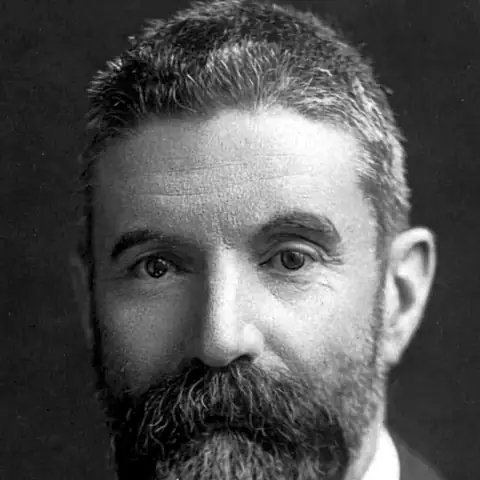
Who was Alfred Deakin?
Alfred Deakin grew up in Melbourne and trained as a barrister before working as a journalist. He won a seat in the Victorian parliament at 23. Later he became a key voice for uniting the Australian colonies and helped write the Constitution. After federation in 1901 he was the country's first Attorney-General. He took over as prime minister from Edmund Barton in 1903 and held the job three times. In 1909 his group joined the free traders in a deal called the Fusion. He stepped down in 1913 and died six years later.
Political views
- His government passed the 1908 law that set up national pensions for older people and for people with disabilities.Source: moadoph.gov.au
- He called his Liberal Protectionists the party of the middle ground, between conservative free traders and extreme socialists.Source: en.wikipedia.org
- His 'New Protection' linked tariffs to fair treatment of workers. Factories behind the tariff wall had to pay fair wages, and prices were policed to protect buyers.Source: moadoph.gov.au
- He supported an arbitration court to settle industrial disputes, with the aim of ending strikes and lock-outs.Source: moadoph.gov.au
- He gave strong weight to the White Australia policy, which aimed to keep out people he described as undesirable and coloured aliens.Source: moadoph.gov.au
- He gave Britain a tariff preference with no strings attached and wanted more British settlers to come.Source: moadoph.gov.au
- He put forward the first bill for compulsory military training and argued for an Australian navy.Source: en.wikipedia.org
Legacy
Many historians rank Deakin among Australia's most important leaders. Admirers say he built the machinery of the new nation, including the High Court, wage arbitration, tariff protection and the first national pensions. Later Liberals counted him among their founders. Critics point out that all of this sat alongside the White Australia policy. Today his speech on the Immigration Restriction Bill is cited as plainly racist. His 1909 Fusion also caused anger. Labor and some liberals said he had dropped his reform agenda, and Labor won the next election.
In their own words
“We have not simply protected the maker, but have provided that the wages must be paid.”