12axes-testTake the test
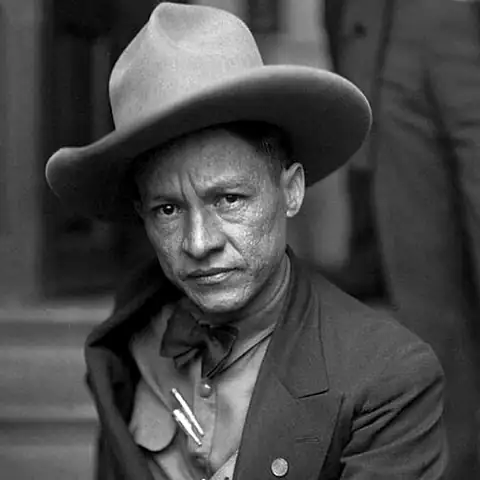
Augusto César Sandino
Historical figureNI1895-1934

Augusto César Sandino

Leader of the Defending Army of the National Sovereignty of Nicaragua · Guerrilla commander against the US Marine occupation (1927-1933)

Nicaraguan guerrilla leader who fought the US Marine occupation from 1927 to 1933 in the name of national sovereignty, backed peasant cooperatives, and was murdered by the National Guard in 1934.

Profile on 12 axes6 of 12 documented
ECONOMYSTATESOCIETYWORLDOwnershipMarketsWelfareAuthoritySecurityStructureMoralityReligionTechnologyCultureTradeForeign
Where they stood

Augusto César Sandino, axis by axis

  1. PublicPrivate

    Sources describe cooperatives and collective farming in the zones his army held, which points clearly toward collective ownership. Scholars disagree on how coherent his program was, so the score stays moderate.

  2. PlannedFree

    He wanted world capital, not only American money, to finance a canal. His supporters ran cooperatives that cut against the private economy. The evidence is thin, so the score is mild.

  3. SharedSelf-reliant
  4. 04AuthorityNo clear record
    DemocraticStrong leader
  5. 05SecurityNo clear record
    LibertyOrder
  6. 06StructureNo clear record
    LocalCentral
  7. 07MoralityNo clear record
    ProgressiveTraditional
  8. 08ReligionNo clear record
    SecularReligious
  9. 09TechnologyNo clear record
    EmbraceCaution
  10. MulticulturalNational identity
  11. GlobalProtected

    He attacked American control of the canal route yet proposed financing it with capital from Latin America and the wider world. This reads as economic sovereignty, not closed borders, so the score is modest.

  12. CooperationStrength

    He fought a foreign occupation by arms and framed the struggle as a regional Latin American cause. Sovereignty and armed resistance lean toward strength, but his appeal to regional solidarity tempers it.

6 axes have no clear record, so matching leaves them out.

Who was Augusto César Sandino?

Augusto César Sandino was born in 1895 in Niquinohomo, Nicaragua, to a poor unmarried mother. He worked in coffee fields and later as a mechanic in Tampico, Mexico, where he met anarchist, socialist and communist ideas. Back home in 1926 he joined the Liberal opposition. When the US Marines landed in 1927 and the Liberal leader Moncada accepted a truce, Sandino refused to stop fighting and founded his own army. From the mountains of Las Segovias his guerrillas harassed the Marines until they left in early 1933. A year later the National Guard seized and killed him.

Political views

  • Rejected the May 1927 truce that ended the Liberal war and kept fighting, insisting he was not for sale.Source: encyclopedia.com
  • Founded the Defending Army of the National Sovereignty of Nicaragua in September 1927 and pressed for social justice for workers and peasants, though scholars dispute how coherent his thinking was.Source: encyclopedia.com
  • In the San Albino Manifesto of July 1927 he called the Marines invaders, accused Washington of arming the Conservative leaders Adolfo Diaz and Emiliano Chamorro, and warned that a US hold on a canal would make Nicaragua subordinate to the Colossus of the North.Source: latinamericanstudies.org
  • Cast his struggle as a regional cause, addressing Nicaraguans, Central Americans and the Indo-Hispanic race and drawing on Indigenous heritage as a source of patriotism.Source: latinamericanstudies.org
  • Proposed that a Nicaraguan canal be financed by world capital, half from Latin America and half from other countries, with the revenue paying for railroads and education.Source: latinamericanstudies.org
  • In the districts his army controlled, his supporters reorganized agriculture along collective lines and built a cooperative movement.Source: newleftreview.org
  • Disarmed his army after the Marines withdrew in early 1933, then was seized by the National Guard in February 1934 and killed with his brother and two generals.Source: encyclopedia.com

Legacy

Many Nicaraguans remember Sandino as the symbol of resistance to foreign domination, and the later Sandinista movement took his name. Admirers credit him with wearing down a far better equipped occupation force and with standing up for peasants and workers. In his own day opinion split over whether he was a patriot or a bandit, and scholars still question whether he had a coherent program. His killing was ordered by Anastasio Somoza Garcia, head of the US-trained National Guard, without consulting President Sacasa. Somoza went on to build a dictatorship that lasted more than four decades, and the Guard broke up the cooperatives, hunted down Sandino's followers and killed hundreds of families.

How close are you to Augusto César Sandino?

Take the 12 Axes test and see which historical figure is your political twin, axis by axis.

Take the test

Augusto César Sandino: questions

Was Sandino a communist?

Not clearly. He met anarchist, socialist and communist ideas while working in Mexico, but his movement stressed national sovereignty and social justice for workers and peasants. Scholars disagree about how coherent his political thought was.

Who killed Augusto Sandino?

Soldiers of the National Guard seized him on 21 February 1934 after a meeting in Managua. The Guard's commander, Anastasio Somoza Garcia, ordered the killing. Sandino's body has never been found.

What was Sandino fighting for?

He fought the US Marine occupation that began in 1927 and the Nicaraguan governments that backed it. His stated aim was to defend national sovereignty, and his supporters also organized cooperatives.

Sources