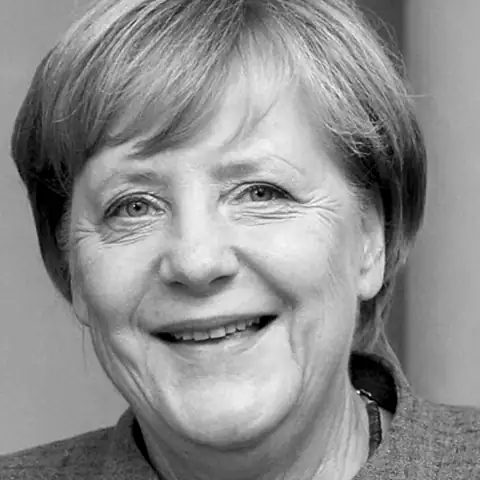
Who is Angela Merkel?
Angela Merkel was raised in East Germany by a Lutheran pastor's family. She trained as a physicist and never joined the ruling SED party. In 1989 she moved into politics, and in 1990 she joined the CDU. Helmut Kohl gave her ministries for women and youth, then for the environment. When Kohl's party funding scandal broke in 1999, she called on the CDU to move away from him. She took over as party chair in 2000. From 2005 to 2021 she was chancellor, heading four governments: three shared with the SPD and one with the FDP. She has since left politics and holds no office.
Political views
- Led the UN climate talks held in Berlin in 1995, which produced the Berlin Mandate to cut greenhouse gases.Source: hdg.de
- Argued for a special partnership between the EU and Turkey instead of full membership.Source: hdg.de
- In the euro crisis she pushed hard for tight budgets. Examples are the savings package of 2010 and the fiscal compact of 2012, which added debt limits.Source: hdg.de
- After the Fukushima disaster in 2011, she decided that all German nuclear plants would close by 2022 and that renewable energy would grow.Source: hdg.de
- Refugees were stranded in Hungary in 2015, and she let them come to Germany. She told the public "Wir schaffen das", meaning we can manage this. About one million asylum seekers arrived that year.Source: hdg.de
- Supported the EU-Turkey agreement of 2016 and the EU's tougher asylum rules agreed in 2018.Source: hdg.de
- Her government ended compulsory military service in 2011.Source: en.wikipedia.org
Legacy
Admirers say Merkel stayed steady in the 2008 banking crash and the euro troubles, kept the EU united and treated refugees humanely. Time magazine named her its Person of the Year for 2015. Critics in southern Europe say her demands for austerity made recessions worse. Some critics in Germany say the 2015 decision was badly planned and split the country. Her Russia policy now draws the sharpest attacks. After Russia seized Crimea in 2014 she still backed the Nord Stream 2 gas pipeline, and critics say this left Germany dependent on Russian gas with a weak army.