12axes-testTake the test
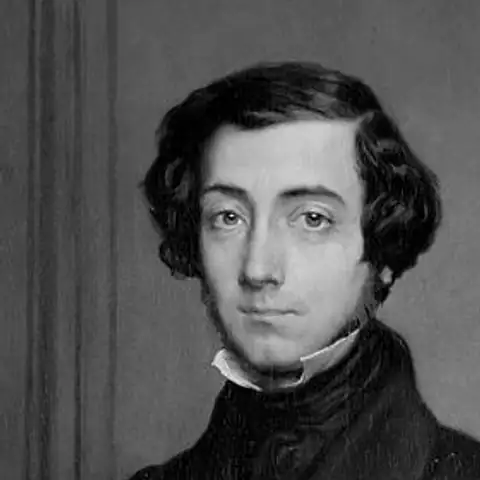
Alexis de Tocqueville
Historical figureFrance1805-1859

Alexis de Tocqueville

Author of Democracy in America · Member of the French Chamber of Deputies

French liberal aristocrat and parliamentarian who wrote Democracy in America, a study of equality, local self-rule, civic groups and the dangers of majority rule and a smothering state.

Profile on 12 axes10 of 12 documented
ECONOMYSTATESOCIETYWORLDOwnershipMarketsWelfareAuthoritySecurityStructureMoralityReligionTechnologyCultureTradeForeign
Where they stood

Alexis de Tocqueville, axis by axis

  1. PublicPrivate
  2. PlannedFree
  3. SharedSelf-reliant

    Leans toward self-reliance because he opposed the socialist schemes of 1848 and preferred citizen associations to state aid. Direct evidence in the sources here is thin.

  4. DemocraticStrong leader

    A dedicated liberal who dreaded both majority tyranny and centralised despotism. He quit public life after the 1851 coup.

  5. LibertyOrder

    He defended free association and civil liberties. After the June Days revolt of 1848 he backed formalising the state of siege, so the score tilts only slightly toward liberty.

  6. LocalCentral
  7. ProgressiveTraditional
  8. SecularReligious
  9. 09TechnologyNo clear record
    EmbraceCaution

    No recorded view, and the 19th-century setting gives no basis for a score.

  10. 10CultureNo clear record
    MulticulturalNational identity

    The sources show no settled view on immigration, so this axis is left empty.

  11. GlobalProtected
  12. CooperationStrength

    Scored toward strength because he supported French rule in Algeria and cared about his country's standing.

2 axes have no clear record, so matching leaves them out.

Who was Alexis de Tocqueville?

Alexis de Tocqueville came from an old Norman noble family and was born in Paris. In 1831 he sailed to America with his friend Gustave de Beaumont, officially to look at prisons. What he wrote instead was Democracy in America, published in two parts in 1835 and 1840. It asked how a society of equals shapes government, habits and faith. He won a seat in the Chamber of Deputies in 1839, helped write the constitution of the Second Republic, and was foreign minister for a short time in 1849. Louis Napoléon's coup in December 1851 ended his career. He retreated to write The Old Regime and the Revolution, which came out in 1856.

Political views

  • Held up the small self-governing township as the root of American freedom, because it taught ordinary people to run their own affairs.Source: gutenberg.org
  • Feared that a democracy could let the majority crush dissent and trample minorities, even without any single ruler.Source: gutenberg.org
  • Imagined a mild but all-powerful state that would look after citizens like children and leave them dependent.Source: gutenberg.org
  • Believed that clubs, societies and other voluntary groups protected citizens from both an overbearing majority and selfish isolation.Source: gutenberg.org
  • Sat with the moderate left in parliament, spoke against slavery and favoured free trade.Source: en.wikipedia.org
  • Backed France's conquest and settlement of Algeria.Source: en.wikipedia.org

Legacy

Tocqueville is often named among the founders of political sociology and comparative politics. Democracy in America is still a standard text on civic life in the United States. Many camps claim him. Liberals value his defence of free institutions and a free press. Conservatives like his respect for religion, family and local life. Writers on civil society build on his praise of associations, and his warning about a gentle, controlling state still turns up in arguments over big government. Critics say he gave too little space to slavery and the fate of Native Americans, though he did condemn both. His support for the conquest of Algeria, including its brutal methods, draws sharp criticism. Some historians also doubt that a nine-month visit could carry such broad claims.

In their own words

“I know no country in which there is so little true independence of mind and freedom of discussion as in America.”
Democracy in America, Volume 1, 1835 (Reeve translation)
“Americans of all ages, all conditions, and all dispositions, constantly form associations.”
Democracy in America, Volume 2, 1840 (Reeve translation)

How close are you to Alexis de Tocqueville?

Take the 12 Axes test and see which historical figure is your political twin, axis by axis.

Take the test

Alexis de Tocqueville: questions

Was Tocqueville a liberal or a conservative?

He is usually called a liberal, and he sat with the moderate opposition in parliament. Still, his respect for religion and local community means conservatives also read him with approval.

What did Tocqueville mean by tyranny of the majority?

He feared that in a democracy, public opinion could become so strong that few people would dare to disagree with it. He thought this pressure could be harder to resist than a king.

Which political party did Tocqueville belong to?

He joined no modern party. Under the July Monarchy he sat with the liberal opposition, and in 1849 he served as foreign minister in a government of the Second Republic that leaned conservative.

Sources