12axes-testTake the test
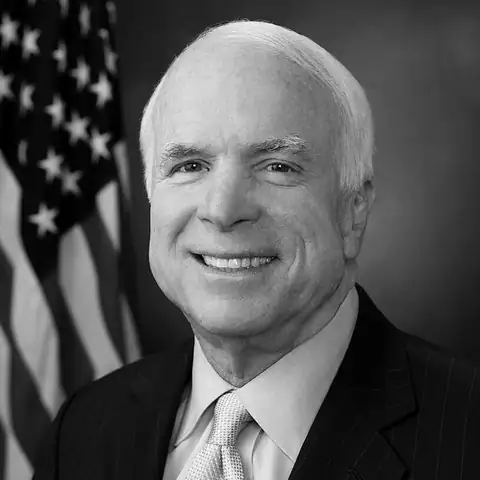
John McCain
Historical figureUnited States1936-2018

John McCain

U.S. Senator from Arizona (1987-2018) · U.S. Representative from Arizona (1983-1987)

Former naval aviator who survived years of captivity in North Vietnam, then spent three decades as an Arizona senator, a defense hawk and the Republican choice for president in 2008.

Profile on 12 axes11 of 12 documented
ECONOMYSTATESOCIETYWORLDOwnershipMarketsWelfareAuthoritySecurityStructureMoralityReligionTechnologyCultureTradeForeign
Where they stood

John McCain, axis by axis

  1. PublicPrivate
  2. PlannedFree

    He called for low taxes and balanced budgets. He also co-sponsored a cap-and-trade climate bill and campaign money rules, so he does not reach the free-market end.

  3. SharedSelf-reliant
  4. DemocraticStrong leader

    Both his push to curb political money and his law against abusive interrogation can be read as support for checks on power.

  5. LibertyOrder

    He supported the Iraq war and big defense budgets. Yet he opposed torture and held that Guantanamo detainees needed a trial. These pull in opposite directions.

  6. LocalCentral
  7. ProgressiveTraditional
  8. SecularReligious
  9. 09TechnologyNo clear record
    EmbraceCaution

    No view on regulating new technologies shows up in the sources, so this is left null.

  10. MulticulturalNational identity

    His support for sweeping immigration bills that offered legal status, in 2006, 2007 and 2013, is the main reason he scores toward the open pole.

  11. GlobalProtected
  12. CooperationStrength

One axis has no clear record, so matching leaves it out.

Who was John McCain?

John McCain was the son of a Navy family and was born in the Panama Canal Zone. He finished at the Naval Academy in 1958. In 1967 his plane was shot down over Hanoi. Over more than five years in captivity he was tortured, and he refused to go home early. He served two terms in the House, won a Senate seat in 1986 and kept it until his death in 2018. He chaired both the Commerce and the Armed Services committees. George W. Bush beat him for the Republican nomination in 2000. He won it in 2008 but lost the election to Barack Obama. The press liked to call him a maverick.

Political views

  • He voted for the war in Iraq in 2003. In 2007 he argued for the troop surge and said no to set dates for pulling out.Source: en.wikipedia.org
  • He and the Democrat Russ Feingold wrote a 2002 campaign finance law aimed at unregulated soft money.Source: en.wikipedia.org
  • His 2005 amendment tied military interrogators to the Army Field Manual, and the Senate approved it 90-9.Source: presidency.ucsb.edu
  • Alongside Ted Kennedy, and later the Gang of Eight, he pushed immigration bills that combined tougher border control with a path to legal status for many undocumented people.Source: en.wikipedia.org
  • With Joe Lieberman he put forward the 2003 Climate Stewardship Act, a cap-and-trade bill that lost 55-43.Source: en.wikipedia.org
  • In 2001 only two Senate Republicans opposed the Bush tax cuts, and he was one. Later on he supported extending them.Source: en.wikipedia.org
  • He was against the Affordable Care Act. Still, in July 2017 his deciding vote helped defeat a partial repeal, 49 to 51.Source: en.wikipedia.org

Legacy

Supporters from both parties admire how he held up in captivity, the laws he wrote on campaign money and torture, and his readiness to defy his own side. He shared a 1999 Profile in Courage Award, and in 2022 received the Presidential Medal of Freedom. Critics on the left blame him for urging war in Iraq and for pressing for action in Libya and Syria. Some conservatives disliked his stands on immigration and climate. In the Keating Five affair the Senate Ethics Committee criticized his 'poor judgment'. His choice of Sarah Palin as his 2008 running mate drew criticism.

In their own words

“For my part, I would rather lose a campaign than a war.”
Speech on Iraq at the Virginia Military Institute, Lexington, 2007

How close are you to John McCain?

Take the 12 Axes test and see which historical figure is your political twin, axis by axis.

Take the test

John McCain: questions

Why did people call John McCain a maverick?

Reporters used the label when he broke with his party's leaders. He did so on campaign finance, on the 2001 tax cuts, on immigration and on the 2017 health care repeal.

Was John McCain a conservative?

He was a Republican who was conservative on defense and taxes. He split with many in his party on immigration, climate and campaign money, and critics on the right often said so.

How long was McCain a prisoner of war?

He was shot down in October 1967 and freed in March 1973. During that time he was tortured. He turned down an early release offer because accepting would have broken the military's Code of Conduct.

Sources