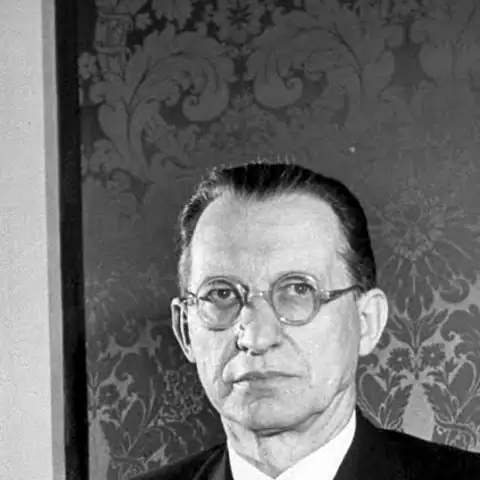
Who was Alcide De Gasperi?
Alcide De Gasperi grew up in Trentino, which belonged to Austria-Hungary, and won a seat in the Austrian parliament. After the region became Italian he led the Catholic Italian People's Party. Mussolini's regime jailed him from 1927 to 1929, and he then worked quietly in the Vatican library. During the war he helped found Christian Democracy. From 1945 to 1953 he headed eight coalition governments. He oversaw the end of the monarchy and the birth of the Italian Republic, and he served as the last prime minister of the kingdom and the first of the republic.
Political views
- Thought that a united Europe was the only safeguard against another round of war and dictatorship, which he had seen first-hand.Source: european-union.europa.eu
- Pictured a Europe where member states worked together and strengthened one another, not one where nations simply disappeared.Source: european-union.europa.eu
- Took Italy into NATO, accepted Marshall Plan aid and built a close partnership with Washington.Source: european-union.europa.eu
- Backed the Schuman Plan for a shared coal and steel authority, and argued that Europe needed a common defence policy.Source: european-union.europa.eu
- Told a Strasbourg audience in 1951 that European bodies lacking a common political purpose would feel cold and without ideals.Source: european-union.europa.eu
- Put democracy, human dignity, European union and social justice at the centre of his politics.Source: fondazionedegasperi.org
- Ran his party as a broad Catholic, anti-communist force in the political centre, governing with smaller secular parties.Source: en.wikipedia.org
Legacy
Supporters say De Gasperi kept Italian democracy steady in a fragile time, helped the economy recover and was one of the people who set European integration in motion. The Catholic Church has started the process that could make him a saint. Critics on the left point to 1947, when he dropped communists and socialists from government, and to his closeness to the United States. His 1953 election law gave bonus seats to a winning coalition and was widely attacked. The coalition missed the threshold, and he left office that year.
In their own words
“The future will not be built through force, nor the desire to conquer, but by the patient application of the democratic method, the constructive spirit of agreement, and by respect for freedom.”