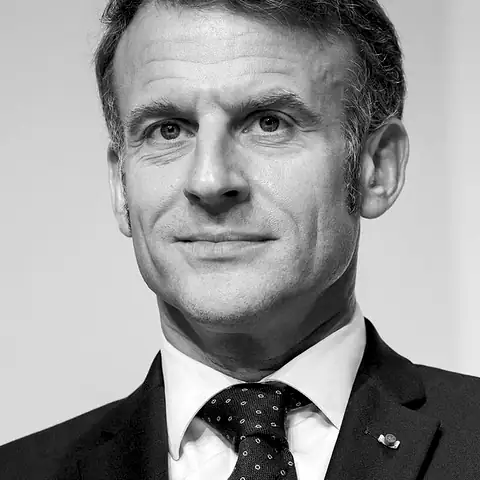
Who is Emmanuel Macron?
Emmanuel Macron was born in 1977 in Amiens. After Sciences Po and the ENA civil service school he worked first as an inspector of finances and then as an investment banker. He served President François Hollande as deputy chief of staff, and between 2014 and 2016 as economy minister. In 2016 he founded En Marche, and the following year he was elected president at the age of 39; Marine Le Pen was his opponent when he won re-election in 2022. A poor showing for his camp in the European elections of June 2024 led him to dissolve the National Assembly, and the result was a parliament with no majority. September 2025 brought Sébastien Lecornu's appointment as prime minister, and after a brief resignation he was reappointed in October 2025. Macron cannot seek a third consecutive term, and his second one finishes in May 2027.
Previously: Founder of En Marche, now Renaissance (2016) · Minister of the Economy, Industry and Digital Affairs (2014-2016) · Deputy Secretary-General of the Elysee Palace (2012-2014)
Documented positions
- His 2017 decrees loosened French labour law, with caps on dismissal awards and more bargaining at company level.Source: hrreporter.com
- The wealth tax gave way to a narrower tax on real estate assets, a change that left-wing critics said made him a president of the rich.Source: connexionfrance.com
- France's legal retirement age rose from 62 to 64 in 2023, a bill he got through using Article 49.3 and thus without a final Assembly vote.Source: cnbc.com
- He pushed for the freedom to have an abortion to be written into France's constitution. Parliament approved the change in March 2024, by 780 votes to 72.Source: opb.org
- His 2022 plans called for six new nuclear reactors, with a study of eight more.Source: world-nuclear-news.org
- The Constitutional Council, to which he referred the 2024 immigration law, struck out over a third of its articles, among them limits on benefits and on family reunification.Source: aljazeera.com
- He announced in September 2025 that 26 countries had committed to a reassurance force for Ukraine for the period after the war ends.Source: aljazeera.com
- Reorganising how Islam is financed and how imams are trained in France is something he has proposed, presenting it as protection for national cohesion and secularism.Source: bridge.georgetown.edu
Record
What supporters credit to Macron includes labour market reform, a revival of nuclear power, constitutional protection for abortion, and a leading role in Europe's support for Ukraine. His critics cite the end of the wealth tax and the yellow vest protests of 2018 and 2019. They also cite the pension reform that went through without a final vote, and the deadlock that followed the 2024 dissolution, when several prime ministers came and went in quick succession.
On 17 October 2026 nationwide protests about living costs and school conditions turned into rioting and looting in several cities, with at least 2,400 arrests. Interior Minister Laurent Nuñez offered his resignation, which Macron refused, asking him instead for full transparency on planning and intelligence failures. Prime Minister Lecornu ordered localised curfews.