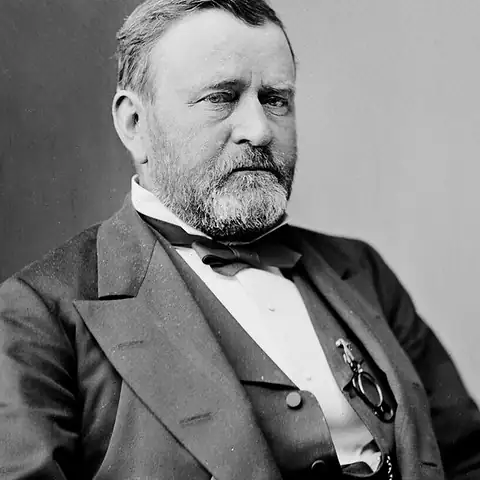
Who was Ulysses S. Grant?
Grant trained at West Point and fought in the Mexican War, but he was little known when the Civil War broke out. By 1865 he was in charge of all Union armies and received Lee's surrender at Appomattox. He ran for president as a Republican, won in 1868 and was re-elected four years later. His two terms saw the passage of the Fifteenth Amendment, federal enforcement of Reconstruction and a Peace Policy toward Native Americans. They also saw scandals among his appointees and the long depression after 1873. Once out of office, he lost his money to a fraudster. He finished his well-regarded memoirs shortly before dying of cancer in 1885.
Political views
- Urged the states to approve the Fifteenth Amendment, which forbids refusing anyone the vote because of race.Source: millercenter.org
- The Ku Klux Klan Act of 1871 became law under him, and he used it against violent terror aimed at Black Southerners.Source: millercenter.org
- Set aside habeas corpus in several South Carolina counties in 1871, and used soldiers to back up marshals who arrested Klansmen.Source: en.wikipedia.org
- Was the first president to call for a professional civil service, and set up the first Civil Service Commission.Source: millercenter.org
- Blocked a bill to print more money in 1874. In 1875 he approved a law that set a date to bring the dollar back to gold.Source: millercenter.org
- Under the 1871 Treaty of Washington, he let an international tribunal decide the Alabama Claims against Britain.Source: millercenter.org
- Proposed a constitutional amendment in 1875 to guarantee free public schooling and keep tax money away from religious schools.Source: en.wikipedia.org
Legacy
Grant's reputation among historians has climbed steadily since the late twentieth century. His admirers argue that no other president of that century did more for Black Americans' rights, citing the Fifteenth Amendment and the war on the Klan, and they praise his diplomacy. Critics, then and today, point to the scandals of his years in office. One of them, the Whiskey Ring, reached his private secretary. They say Grant trusted the wrong men. His Peace Policy sought to assimilate Native Americans, yet the Great Sioux War of 1876 and the seizure of the Black Hills followed. Many also remember the 1862 order against Jews in his district, which Lincoln canceled and Grant later regretted.