12axes-testTake the test
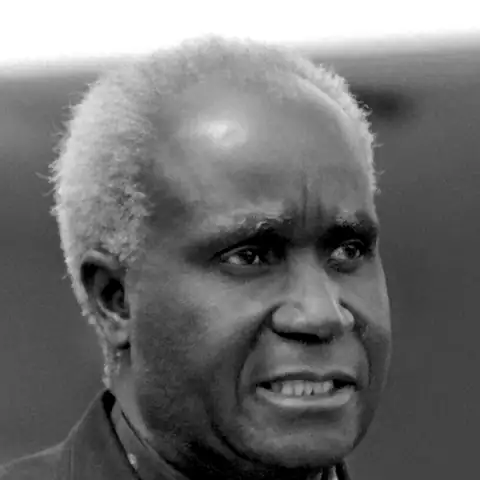
Kenneth Kaunda
Historical figureZM1924-2021

Kenneth Kaunda

First President of Zambia (1964-1991) · President of the United National Independence Party

Zambia's independence leader and first president, who preached Zambian humanism, nationalized the copper mines, ran a one-party state from 1972 and gave up power after losing the 1991 election.

Profile on 12 axes7 of 12 documented
ECONOMYSTATESOCIETYWORLDOwnershipMarketsWelfareAuthoritySecurityStructureMoralityReligionTechnologyCultureTradeForeign
Where they stood

Kenneth Kaunda, axis by axis

  1. PublicPrivate

    The 1968 Mulungushi reforms took 51 percent or more of key foreign firms, and the state later held the mines. Foreign banks resisted takeover, so the score is not as far left as Nyerere's.

  2. PlannedFree

    State holding companies dominated the economy until the 1987 break with the IMF. He announced partial privatization in 1990.

  3. SharedSelf-reliant

    He kept food subsidies until IMF-backed cuts set off urban riots, which points to a shared-provision stance. Little else is documented, so confidence is modest.

  4. DemocraticStrong leader

    He banned other parties in 1972 and filled prisons with critics. He also called the 1991 election and handed power to the winner, so the score is strong but not extreme.

  5. LibertyOrder
  6. LocalCentral
  7. 07MoralityNo clear record
    ProgressiveTraditional
  8. 08ReligionNo clear record
    SecularReligious
  9. 09TechnologyNo clear record
    EmbraceCaution
  10. 10CultureNo clear record
    MulticulturalNational identity
  11. 11TradeNo clear record
    GlobalProtected
  12. CooperationStrength

    He hosted the ANC, ZAPU and ZANU despite South African raids and chaired the OAU twice.

5 axes have no clear record, so matching leaves them out.

Who was Kenneth Kaunda?

Kaunda was born in 1924 at Lubwa Mission in Chinsali, in what was then Northern Rhodesia. A teacher by training, he rose in the African National Congress and in 1960 became president of the United National Independence Party after his release from detention. Zambia became independent on 24 October 1964 with Kaunda as its first president. He outlawed rival parties in 1972, nationalized key industries and sheltered southern African liberation movements. Falling copper prices wrecked the economy, and in 1991 he lost a multi-party election to Frederick Chiluba. He died in 2021 at age 97.

Political views

  • He developed a national ideology called Zambian Humanism and published several books to explain it.Source: newworldencyclopedia.org
  • The April 1968 Mulungushi reforms aimed to take majority stakes of 51 percent or more in key foreign-owned firms.Source: newworldencyclopedia.org
  • By January 1970 the state held majority stakes in the two major foreign mining operations, which merged into ZCCM in 1982.Source: newworldencyclopedia.org
  • After violence in the 1968 elections he grew intolerant of opposition. In 1972 the assembly made UNIP the only legal party.Source: newworldencyclopedia.org
  • Prisons filled with political opponents and critics of the president after 1972, and rivals such as Simon Kapwepwe were blocked from running.Source: newworldencyclopedia.org
  • He hosted the headquarters of ZAPU, ZANU and the ANC despite South Africa's destabilisation campaign, and chaired the Organisation of African Unity in 1970-71 and 1987-88.Source: sahistory.org.za
  • IMF-backed cuts to food subsidies in the mid-1980s caused urban riots. He broke with the IMF in May 1987 and announced partial privatization in 1990.Source: newworldencyclopedia.org
  • He called multi-party elections in 1991 and left office when Chiluba was inaugurated on 2 November 1991.Source: newworldencyclopedia.org

Legacy

Admirers honor Kaunda as Zambia's founding father, as a backer of southern African liberation movements at real cost to his own country, and as a leader who left office after losing the 1991 election. Critics charge that his one-party rule from 1972 jailed opponents, built a personality cult around his humanism, and shut out rivals. They also say that state control and dependence on copper left Zambia deeply in debt when prices fell in the 1970s. He later worked on HIV/AIDS and was accused over a failed 1997 coup attempt before retiring from politics.

How close are you to Kenneth Kaunda?

Take the 12 Axes test and see which historical figure is your political twin, axis by axis.

Take the test

Kenneth Kaunda: questions

What was Zambian Humanism?

Kaunda's national ideology, set out in several books. Critics say he used it to build a personality cult once most opposition had been removed.

Why did Kaunda ban opposition parties?

After violence at the 1968 elections he grew intolerant of opposition. In 1972 the assembly made his UNIP the only legal party, and Zambia stayed a one-party state until 1991.

How did Kenneth Kaunda lose power?

Pressure for multi-party politics led him to call elections in 1991. The Movement for Multiparty Democracy won, and he left office when Frederick Chiluba was inaugurated on 2 November 1991.

Sources