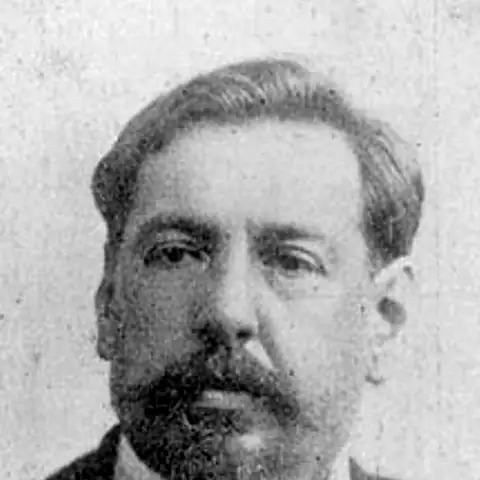
Who was José Batlle y Ordóñez?
José Batlle y Ordóñez was born in 1856 and became a journalist and a leader of Uruguay's Colorado Party. In 1886 he joined the Quebracho revolt and founded the newspaper El Día. He was elected deputy in 1893 and senator in 1896. Chosen president by the General Assembly in 1903, he put down Blanco uprisings and abolished the death penalty. After years in Europe he returned for a second term from 1911 to 1915, in which he expanded state enterprise and social law. His supporters called his program Batllism, and the first decades of the twentieth century are known in Uruguay as the Batllist Era.
Political views
- A historical summary calls him a non-Marxist social democrat and an anticleric who wanted a strong state role in the economy, influenced by Henry George on land.Source: countrystudies.us
- In 1911 and 1912 his government nationalized the Banco de la República and set up a state electric company with a monopoly on power. In 1914 it bought a tramway and railway company.Source: countrystudies.us
- He proposed a progressive land-use tax and an inheritance surcharge to limit large estates, but landowners resisted and little was achieved.Source: countrystudies.us
- His program included unemployment compensation in 1914, free high schools, and an eight-hour workday that became law in 1915.Source: countrystudies.us
- Under his leadership crucifixes were banned in state hospitals in 1906 and religious teaching was removed from public schools in 1909.Source: countrystudies.us
- He pushed for divorce by mutual consent in 1910 and for women's right to seek divorce without cause in 1912, and he encouraged women to attend university.Source: countrystudies.us
- In 1913 he proposed replacing the presidency with a nine-member executive inspired by the Swiss model. The 1917 constitution adopted this only in part and formally separated church and state.Source: countrystudies.us
- He backed the 10 February 1898 coup, then broke with its leader in 1901.Source: encyclopedia.com
Legacy
Admirers credit Batlle with building one of Latin America's earliest welfare states, with secular schools, divorce rights and public utilities that stayed in state hands. His ideas remain central to Uruguayan politics. Critics point out that landowners, British capital, the army and the Blanco Party fought him and that his land reform largely failed. His collective executive split his own party and was only partly adopted. After his death in 1929 the Depression halted many reforms. He also had backed a coup in 1898, which sits uneasily with the democratic order he later promoted.