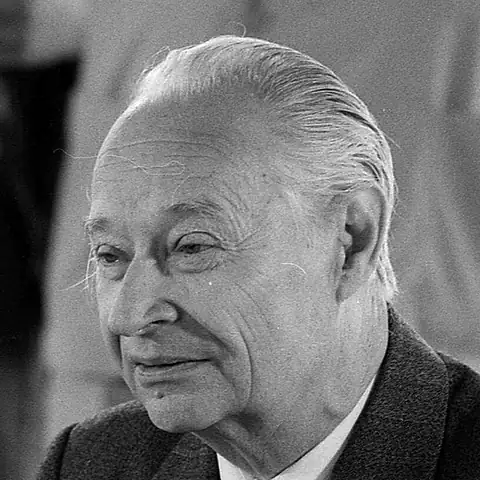
Who was Alexander Dubček?
Alexander Dubček, born in 1921, joined the underground Communist Party in 1938 and fought as an anti-Nazi guerrilla. He rose through the Slovak party and in January 1968 replaced Antonín Novotný as party leader. His government ended censorship and promised a new model of socialism, but Warsaw Pact forces invaded on 20-21 August 1968, and he ordered no armed resistance. Under Soviet pressure he ended the reforms, and Gustáv Husák replaced him in 1969. He was expelled from the party in 1970. After the 1989 Velvet Revolution he became chairman of the Federal Assembly and died in 1992.
Political views
- Aimed at 'socialism with a human face', reforming communism while keeping Czechoslovakia in the Soviet bloc.Source: encyclopedia.com
- His government ended state censorship, allowed public criticism of officials and loosened state control over unions, farms and industry.Source: encyclopedia.com
- The April 1968 Action Program called for democratizing the National Front and the electoral system, federalizing the state, and constitutionally guaranteeing freedom of assembly and expression.Source: countrystudies.us
- Insisted reform proceed under Communist Party direction, urging moderation against both conservatives who wanted repression and popular demands for faster change.Source: countrystudies.us
- Reaffirmed the Soviet alliance, and after Warsaw Pact demands in July 1968 he rejected the ultimatum and asked for bilateral talks with Moscow.Source: countrystudies.us
- Ordered no armed resistance to the August 1968 invasion; under Soviet pressure he then ended the reforms.Source: encyclopedia.com
- After 1989 became chairman of the Federal Assembly and received the Sakharov Prize.Source: encyclopedia.com
Legacy
Admirers see Dubček as the reformer who showed communism could be softened and who stayed popular to the end. Czechoslovakia's reform briefly freed the press and public debate, and he was honored with the Sakharov Prize after 1989. Critics note he was a lifelong communist who always kept the party at the center of reform, that radicals thought him too slow, and that his giving in to Soviet pressure helped end the experiment. After Husák replaced him in April 1969, censorship and travel limits returned. Dubček spent about eighteen years as a forestry official under restrictions. He died in 1992 after a car accident.