12axes-testTake the test
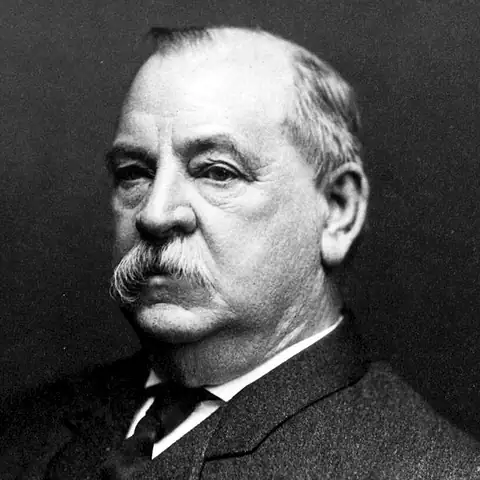
Grover Cleveland
Historical figureUnited States1837-1908

Grover Cleveland

22nd and 24th President of the United States (1885-1889, 1893-1897) · Governor of New York

Conservative Democrat and the only man to win two separate presidential terms, known for honesty, low tariffs, hard money, a small federal role and sending troops against the Pullman strike.

Profile on 12 axes9 of 12 documented
ECONOMYSTATESOCIETYWORLDOwnershipMarketsWelfareAuthoritySecurityStructureMoralityReligionTechnologyCultureTradeForeign
Where they stood

Grover Cleveland, axis by axis

  1. PublicPrivate

    There was no real debate over public ownership in his day. The score rests on his defence of private business and his rejection of federal subsidies.

  2. PlannedFree

    A hard-money man. He pushed the Sherman Silver Purchase Act off the books and borrowed from bankers to defend the gold standard. He did sign the Interstate Commerce Act, which regulated railroads.

  3. SharedSelf-reliant

    His 1887 veto of drought seed aid for Texas came with the line that the people support the government, not the reverse. Many private pension bills met the same fate.

  4. DemocraticStrong leader

    He used the veto as a brake on Congress and stayed within constitutional limits, so he leans democratic.

  5. LibertyOrder

    Federal troops broke the Pullman strike of 1894 on his orders, against the wishes of the Illinois governor.

  6. LocalCentral

    He wanted a small federal role in the economy and social life. Yet he overrode a governor to send troops in the Pullman strike, so he leans only mildly local.

  7. 07MoralityNo clear record
    ProgressiveTraditional

    No known position on family life or social norms beyond the habits of his age, so there is no score.

  8. 08ReligionNo clear record
    SecularReligious

    The sources used here do not show where he stood on religion and government, so there is no score.

  9. 09TechnologyNo clear record
    EmbraceCaution

    No known view, and the question hardly fits his century, so there is no score.

  10. MulticulturalNational identity

    He condemned mob violence against Chinese immigrants but later backed excluding them. He signed the Dawes Act, aimed at assimilating Native Americans, and later vetoed a literacy test for immigrants.

  11. GlobalProtected

    Lower tariffs were his main cause, and he campaigned on them in 1888 and 1892.

  12. CooperationStrength

    He withdrew the Hawaii treaty because he believed Americans had helped topple the Hawaiian queen, yet he warned Britain over the Venezuela boundary. Overall he sits near the middle.

3 axes have no clear record, so matching leaves them out.

Who was Grover Cleveland?

Grover Cleveland practised law in Buffalo and won a name for honesty as sheriff, then mayor, then governor of New York. In 1884 he won the White House, the first Democrat to do so since the Civil War. Benjamin Harrison beat him in the 1888 electoral count even though Cleveland took more votes nationwide. He beat Harrison in 1892, so he is the only president with two terms that did not follow each other. The Panic of 1893 and a long depression marked his second term, along with the Pullman strike and a party fight over silver. That fight led Democrats to choose William Jennings Bryan in 1896.

Political views

  • Fought the 1888 and 1892 campaigns on lowering tariffs and attacked the Republican policy of protection.Source: millercenter.org
  • In 1887 he vetoed a bill to buy seed grain for Texas farmers hit by drought. He said such aid would erode self-reliance and private charity.Source: millercenter.org
  • Held the Sherman Silver Purchase Act responsible for the depression and got it repealed. To rebuild the gold reserve he then issued bonds.Source: millercenter.org
  • Sent soldiers to deal with the Pullman strike in 1894, although the Illinois governor did not want them.Source: millercenter.org
  • Signed the 1887 Dawes Act, which split reservation land into individual plots.Source: millercenter.org
  • Rejected the annexation of Hawaii once he decided that Americans had plotted to remove its government.Source: millercenter.org
  • Insisted that Britain accept arbitration in its boundary quarrel with Venezuela, and sent warships to the region.Source: millercenter.org

Legacy

Admirers praise Cleveland for honesty, for standing up to his own party and to lobbyists, and for using the veto more than any president before him against pension and special-interest bills. Fiscal conservatives hold him up as a model of small government. Critics say his firm loyalty to gold and his refusal to offer relief made the depression of the 1890s worse. Labor historians condemn the troops and court orders he used to crush the Pullman strike. His backing of the Dawes Act helped strip Native Americans of most of their remaining land in later decades. Historians also point out that he did little against segregation and the loss of Black voting rights in the South.

In their own words

“Though the people support the Government the Government should not support the people.”
Veto of the Texas Seed Bill, 1887

How close are you to Grover Cleveland?

Take the 12 Axes test and see which historical figure is your political twin, axis by axis.

Take the test

Grover Cleveland: questions

Was Grover Cleveland a conservative?

Yes, in the 19th-century sense. He was a Democrat from the pro-business Bourbon wing. He backed the gold standard, low tariffs and a small federal government, and he opposed handouts from Washington.

Who was the only president to serve two non-consecutive terms?

Grover Cleveland. He won in 1884, then lost the 1888 electoral count to Benjamin Harrison even though more people had voted for him. In 1892 he beat Harrison in a rematch.

Why did Cleveland send troops to the Pullman strike?

In 1894 he wanted the mail and the railways kept running. He sent troops to Chicago although Illinois Governor John Altgeld objected. The strike fell apart and its leaders went to jail.

Sources