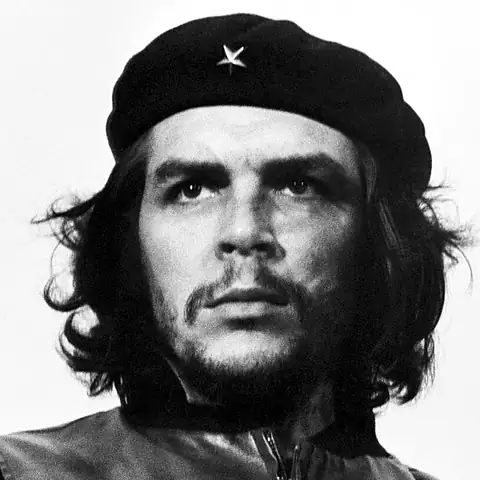
Who was Che Guevara?
Ernesto Guevara came into the world in 1928 in Rosario, Argentina. He studied medicine in Buenos Aires. Journeys around Latin America, and the US-backed overthrow of Guatemala's government in 1954, shaped his belief in armed revolt. He joined Fidel Castro in Mexico, sailed with him to Cuba in 1956 and became one of the revolution's top commanders. After victory he ran La Cabaña fortress, the national bank and then the ministry of industries. In 1965 he left Cuba to take the guerrilla fight to Africa and then South America. Bolivian soldiers captured him and shot him on 9 October 1967.
Political views
- He called for armed guerrilla war and worldwide revolution, and he blamed poverty in the developing world on imperialism and monopoly capital.Source: marxists.org
- He believed a socialist economy should abandon market relations and the law of value, which he thought alienated workers.Source: marxists.org
- He wanted socialism to produce a new kind of person, one who worked for moral reasons rather than for pay.Source: en.wikipedia.org
- In his view the party should be a vanguard of the most committed workers, leading the masses by setting an example.Source: marxists.org
- At the United Nations in 1964 he said peaceful coexistence could not cover colonial rule, and he attacked apartheid and Washington's role in Latin America.Source: marxists.org
- In 1965 he charged that socialist states were quietly helping the West exploit poor countries.Source: en.wikipedia.org
Legacy
Guevara turned into one of the best-known faces of the 20th century. Supporters see a symbol of idealism, anti-imperialism and sacrifice, and much of the left honors him as a martyr. Critics call him an authoritarian who backed violence against opponents. In 1959, at La Cabaña, he looked over appeals from the revolutionary courts, which sentenced hundreds to death. Estimates of executions under his authority run from 55 to 105. He also created the Guanahacabibes labor camp to punish state workers. Both of his later guerrilla ventures, in the Congo and in Bolivia, failed, and people still argue over how to weigh his ideals against his use of force.
In their own words
“At the risk of seeming ridiculous, let me say that the true revolutionary is guided by great feelings of love.”