12axes-testTake the test
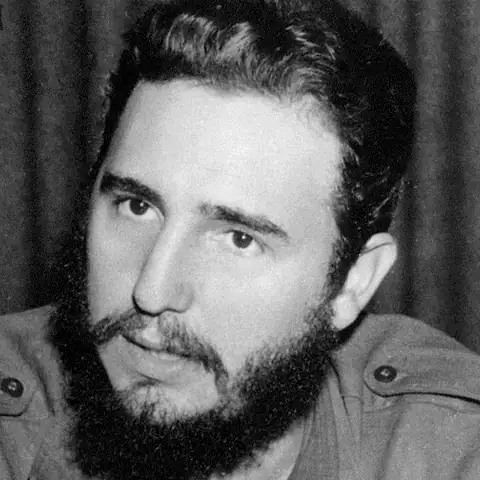
Fidel Castro
Historical figureCuba1926-2016

Fidel Castro

Prime Minister of Cuba (1959-1976) · President of the Council of State of Cuba (1976-2008)

Cuban revolutionary who toppled Batista in 1959 and led a one-party communist state for almost fifty years, widening health care and schooling while jailing and silencing opponents.

Profile on 12 axes10 of 12 documented
ECONOMYSTATESOCIETYWORLDOwnershipMarketsWelfareAuthoritySecurityStructureMoralityReligionTechnologyCultureTradeForeign
Where they stood

Fidel Castro, axis by axis

  1. PublicPrivate
  2. PlannedFree
  3. SharedSelf-reliant
  4. DemocraticStrong leader
  5. LibertyOrder
  6. LocalCentral
  7. ProgressiveTraditional

    In the 1960s gay men were put in UMAP work camps, and jailings went on after that. Castro took the blame for this in 2010. The score is mildly traditional because of that record.

  8. SecularReligious

    He claimed the revolution had nothing against faith. Yet the state sent foreign priests out of the country, took over church-run schools and pressed hard on Protestant groups. Party membership stayed closed to believers until the 1990s.

  9. 09TechnologyNo clear record
    EmbraceCaution
  10. MulticulturalNational identity

    He was a Cuban nationalist as well as a Marxist-Leninist. No lasting stance on immigration is recorded, so the score leans mildly toward national identity.

  11. 11TradeNo clear record
    GlobalProtected

    Trade with other countries was run by the state and tied to the Soviet bloc. That shows up in the markets score. No separate stance on tariffs is recorded, so this is null.

  12. CooperationStrength

    About 370,000 Cuban troops served in Angola over the years, and others went to Ethiopia. He also urged revolution across Latin America, yet took part in the Non-Aligned Movement. Scored toward strength.

2 axes have no clear record, so matching leaves them out.

Who was Fidel Castro?

Fidel Castro was born in 1926 in eastern Cuba, the son of a prosperous landowner, and became a lawyer. In 1953 he led a failed assault on the Moncada barracks and went to prison. He later fought a guerrilla war from the Sierra Maestra mountains. Dictator Fulgencio Batista fled at the end of 1958, and Castro took charge as prime minister. His government seized land and industry, and in 1961 he declared the revolution socialist. He outlasted the Bay of Pigs invasion and the missile crisis of 1962. Illness made him pass power to his brother Raúl between 2006 and 2008. He died in Havana in 2016.

Political views

  • At his 1953 trial he promised to bring back the 1940 constitution, give land to small tenant farmers and let workers share company profits.Source: marxists.org
  • The 1959 agrarian reform took over sugar, oil refining and land owned by foreigners, and it limited how much land one person could own.Source: en.wikipedia.org
  • Declared Cuba socialist in 1961 and waved away multiparty elections, saying that a popular revolution was an election every day.Source: marxists.org
  • Defended the revolutionary tribunals, saying that revolutionary justice depends on moral conviction and not on legal rules.Source: en.wikipedia.org
  • Announced that private schools would be nationalized and that foreign priests who opposed the revolution would be expelled.Source: marxists.org
  • Spread free health care and free schooling and ran a national literacy campaign.Source: en.wikipedia.org

Legacy

Supporters, including Nelson Mandela, respected Castro for defying Washington and for helping the fight against apartheid in southern Africa. They also point to Cuba's schools and clinics. Opponents call him a dictator who kept control for decades and never allowed free elections. In the first weeks of 1959, tribunals shot over 300 men linked to Batista. The historian Hugh Thomas put the total at perhaps 5,000 by 1970. After the Bay of Pigs invasion, thousands of suspected enemies were locked up, and gay men and dissidents ended up in labor camps. Human Rights Watch concluded that his state systematically denied Cubans their basic rights.

In their own words

“Condemn me. It does not matter. History will absolve me.”
History Will Absolve Me, defense speech at the Moncada trial, 1953 (English translation)

How close are you to Fidel Castro?

Take the 12 Axes test and see which historical figure is your political twin, axis by axis.

Take the test

Fidel Castro: questions

Was Fidel Castro a socialist or a communist?

He was both in practice. In 1961 he declared the revolution socialist and called himself a Marxist-Leninist. The Communist Party of Cuba was formed in 1965, and he was its first secretary until 2011.

Was Fidel Castro a dictator?

Critics say yes. He ruled a one-party state with no free elections, controlled the press and jailed opponents. Supporters point to gains in health care and education, but those do not change how power was held.

What did Fidel Castro do for Cuba?

His government built free health care and schools and cut illiteracy. It also nationalized the economy, jailed dissidents and executed opponents. Over a million Cubans left for the United States between 1959 and 1993.

Sources