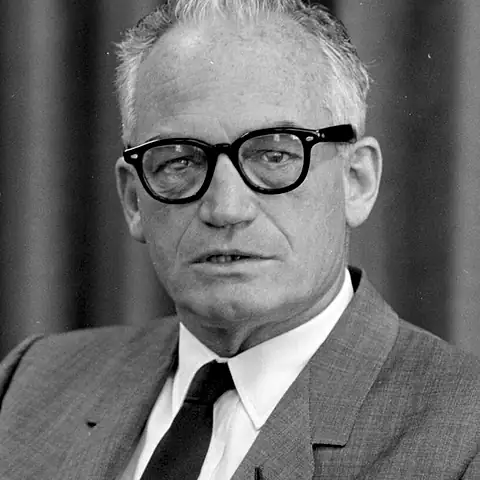
Who was Barry Goldwater?
Barry Goldwater ran a family business in Arizona before entering politics. He founded the state's Air National Guard and won a Senate seat in 1952, serving five terms in all. In 1960 he published The Conscience of a Conservative, which called for a much smaller federal government, more power for the states and a tough line on communism. In 1964 he beat the party's moderates to become its presidential nominee, then lost badly to Lyndon B. Johnson. He won only Arizona and five states in the Deep South. Back in the Senate, he grew more libertarian on social questions.
Political views
- In his 1964 acceptance speech he warned against piling power in a few hands and described the federal system as a brake on government.Source: en.wikipedia.org
- He floated the ideas of making Social Security optional and selling off the Tennessee Valley Authority.Source: presidency.ucsb.edu
- He rejected the New Deal approach, and was especially hostile to its close ties with the labor unions.Source: en.wikipedia.org
- He had backed the 1957 civil rights law but voted no on the 1964 act, because of its sections on public businesses and jobs. He later said the vote was among his biggest regrets.Source: en.wikipedia.org
- He saw communism as the main threat to world peace and said that keeping the peace took watchfulness and strong armed forces.Source: presidency.ucsb.edu
- He co-sponsored the Goldwater-Nichols Act of 1986. It reorganized the military's chain of command and strengthened civilian control.Source: en.wikipedia.org
Legacy
Goldwater lost by a wide margin, yet many historians call 1964 a turning point. His run trained a generation of conservative activists, shifted Republican strength to the South and West, and gave Ronald Reagan his first national stage through his speech 'A Time for Choosing'. Admirers such as conservatives and libertarians, praise his steady belief in limited government and his later break with the religious right. Critics say his no vote on the 1964 civil rights law and his talk about nuclear weapons frightened voters, and some historians tie his Deep South wins to a racial realignment. In 1974 he told Richard Nixon to resign.
In their own words
“I would remind you that extremism in the defense of liberty is no vice. And let me remind you also that moderation in the pursuit of justice is no virtue.”