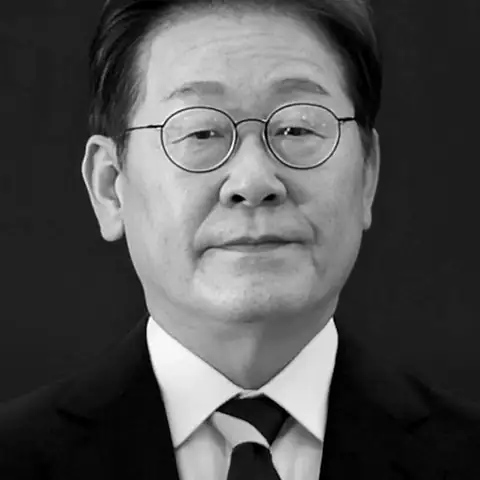
Who is Lee Jae-myung?
Lee Jae-myung served as mayor of Seongnam from 2010 to 2018 and governor of Gyeonggi Province from 2018 to 2021. He narrowly lost the 2022 presidential election, then led the Democratic Party and won a seat in the National Assembly. After the removal of President Yoon Suk Yeol, he won a snap election on 3 June 2025 and began a five-year term the next day. His government took office with a platform of prosecutorial reform and an economic strategy built around AI and large public investment funds.
Previously: Leader of the Democratic Party of Korea (2022-2024) · Member of the National Assembly for Incheon (2022-2025) · Governor of Gyeonggi Province (2018-2021) · Mayor of Seongnam (2010-2018)
Documented positions
- He said in the May 2025 campaign that Korea's trade and foreign policy should follow national interest, that it should avoid relying on one partner, and that it should keep good relations with China while cooperating with the US and Japan.Source: koreaherald.com
- He backs expanding conventional military capabilities under the US nuclear deterrent, with the goal of denuclearizing the Korean Peninsula.Source: koreaherald.com
- In his September 2026 UN General Assembly speech he proposed "peaceful coexistence" with North Korea, built on inclusivity, stability and responsibility, and a lasting peace regime.Source: nknews.org
- The National Assembly passed a bill in September 2025, 174 votes to 1, to abolish the Prosecution Service and replace it with an indictment office and a Serious Crimes Investigation Agency; the People Power Party did not vote.Source: koreajoongangdaily.com
- A Criminal Procedure Act amendment passed on 31 July 2026 removed prosecutors' power to run their own follow-up investigations after police hand over a case.Source: upi.com
- His July 2025 trade agreement with the US capped the reciprocal tariff on Korean goods at 15% in return for a $350 billion investment package and $100 billion of US energy purchases over four years.Source: koreaherald.com
- His government pledged 10 trillion won for AI investment in 2026 and set up a 150 trillion won National Growth Fund for AI, semiconductors and biotechnology.Source: bowergroupasia.com
Record
Courts have suspended the criminal cases against Lee since he became president, relying on Article 84 of the Constitution, which bars criminal prosecution of a sitting president except for insurrection and foreign aggression. On 16 October 2026 the Seoul High Court's chief judge told a National Assembly audit that the remand trial on a Public Official Election Act charge was on hold on that basis. Lee has denied wrongdoing in the cases and said prosecutors "went too far" in indicting him over money sent to North Korea. Realmeter polling put his approval at 35.3% in late October 2026, while Gallup showed 40%, with housing, the economy and a September landmine explosion on the border cited as pressures.
Supporters credit him with ending prosecutors' dual investigative and charging power and with a stable trade settlement; critics, including the People Power Party, argue the reforms remove checks on the government and that his North Korea policy is too soft.