12axes-testTake the test
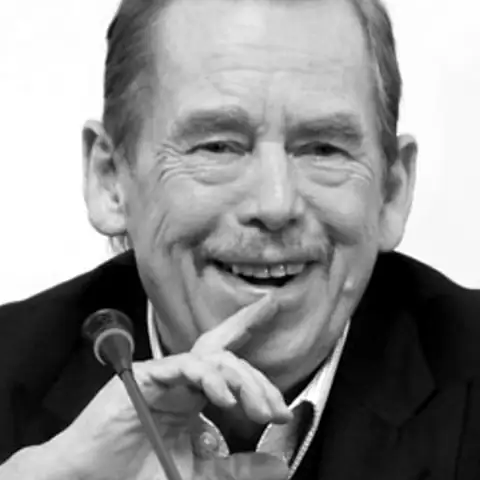
Václav Havel
Historical figureCzechia1936-2011

Václav Havel

President of Czechoslovakia (1989-1992) · President of the Czech Republic (1993-2003)

Czech playwright and dissident. He became the face of the Velvet Revolution in 1989, then served as the last president of Czechoslovakia and the first of the Czech Republic.

Profile on 12 axesAll 12 documented
ECONOMYSTATESOCIETYWORLDOwnershipMarketsWelfareAuthoritySecurityStructureMoralityReligionTechnologyCultureTradeForeign
Where they stood

Václav Havel, axis by axis

  1. PublicPrivate

    He supported the shift to a market economy after 1989 but cautioned against letting economic interests creep into politics. The score is moderately private.

  2. PlannedFree
  3. SharedSelf-reliant
  4. DemocraticStrong leader
  5. LibertyOrder
  6. LocalCentral

    He worked to hold the Czechoslovak federation together, and he also pressed for a stronger civil society and self-government in the regions.

  7. ProgressiveTraditional
  8. SecularReligious

    He often spoke about transcendence and moral duty but did not belong to a church. The score is near neutral.

  9. EmbraceCaution

    His essays criticized an impersonal technological civilization. The mild lean toward caution is a judgment call.

  10. MulticulturalNational identity
  11. GlobalProtected
  12. CooperationStrength

Who was Václav Havel?

Havel's family owned businesses, so the communist authorities refused him a place to study the humanities. He took work as a stage technician until his 1963 play The Garden Party made his name. The Warsaw Pact invasion of 1968 got his work banned. He helped found Charter 77, which said that Czechoslovakia was breaking its own human rights promises, and he went to prison several times, most recently from 1979 to 1983. When the Velvet Revolution came in November 1989, he led the Civic Forum. He was made president on 29 December that year, brought in free elections and stayed on as Czech president until 2003.

Political views

  • In 1977 he helped launch Charter 77, a movement that called for respect for human rights in Czechoslovakia.Source: vaclavhavel.cz
  • In an open letter to the leader Gustáv Husák in 1975, he looked at the moral damage caused by the harsh order that followed 1968.Source: vaclavhavel.cz
  • In 1978 he co-founded VONS, a committee that recorded trials brought for political reasons.Source: vaclavhavel.cz
  • He stood for the rule of law and wanted a Senate, an Ombudsman and a Constitutional Court. He also spoke out when the rights of minorities were broken.Source: vaclavhavel.cz
  • He warned that political parties and economic interests had too much sway over public life.Source: vaclavhavel.cz
  • He urged cooperation among Central European states, an end to the Warsaw Pact and entry into Western defence bodies.Source: vaclavhavel.cz
  • He backed the Czech Republic's entry into NATO and the European Union.Source: vaclavhavel.cz
  • In 1990 he took the lead in bringing Czechoslovak, Hungarian and Polish leaders together, which grew into the Visegrad group.Source: vaclavhavel.cz

Legacy

Abroad, Havel stands for human rights and change without violence, and the library in his name calls him a symbol of the shift from dictatorship to democracy. At home his popularity slipped in the late 1990s as rival politicians and tabloids went after him. A 1997 speech on the moral health of Czech society and its politicians sharpened his quarrels with party leaders. Some critics, among them economic liberals, thought his stress on morals and civil society was vague. He also could not stop Czechoslovakia from splitting in 1992, which he had wanted to avoid.

In their own words

“Our country is not prospering.”
First presidential New Year's address, Prague Castle, 1 January 1990

How close are you to Václav Havel?

Take the 12 Axes test and see which historical figure is your political twin, axis by axis.

Take the test

Václav Havel: questions

Was Václav Havel a liberal?

He is usually called a liberal humanist. He favored markets and NATO, but he was wary of consumerism, party politics and thinking only in terms of money.

What was Charter 77?

It was a text and citizens' movement from 1977. Havel was one of its founders, and it accused the communist government of ignoring its human rights commitments.

Did Václav Havel belong to a political party?

No. In 1989 he headed the Civic Forum movement, and he served as president without a party label, although liberal and environmentally minded groups were his closest allies.

Sources

Portrait: Václav Havel cut out.jpg by Ondřej Sláma, CC BY-SA 3.0, via Wikimedia Commons. Cropped and converted to grayscale by 12axes-test.com.