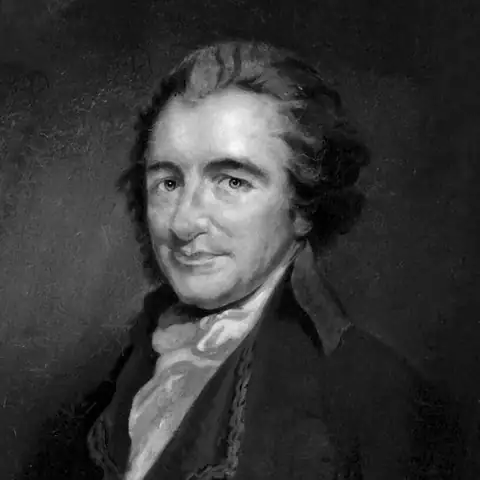
Who was Thomas Paine?
Born in Thetford, England, Thomas Paine moved to Philadelphia in 1774. Two years later his pamphlet Common Sense helped turn opinion toward independence, and his Crisis essays kept up the spirits of the patriot side during the war. Returning to Europe, he wrote Rights of Man in support of the French Revolution, and Britain outlawed him for it. French voters sent him to the National Convention. There he argued against putting Louis XVI to death, and later he was jailed himself. He came back to the United States after the Peace of Amiens. We list him under America, since his most influential writing was done there. He died in 1809.
Political views
- Attacked organised religion in The Age of Reason and argued for deism instead.Source: gutenberg.org
- Described society as a blessing and government, at its best, as a necessary evil.Source: gutenberg.org
- Called hereditary kingship absurd and wanted representative republics to take its place.Source: plato.stanford.edu
- Believed that taking away a person's vote leaves them under another person's will.Source: plato.stanford.edu
- Proposed old-age pensions, schooling for poor children and support for new mothers, paid for by taxes that rose with wealth.Source: plato.stanford.edu
- Thought trade would tie nations together and leave Europe's system of war out of date.Source: plato.stanford.edu
Legacy
Common Sense was among the best-selling pamphlets of the American Revolution. Beyond it, Paine helped spread the case for universal rights, democratic republics and public support for people in need. Historians of the welfare state treat Agrarian Justice as an early plan for a capital grant to all and for old-age pensions, and backers of basic income still cite it. British radicals went on reading Rights of Man for decades. In his own lifetime, many thought him dangerous. After he came back to America he was attacked for his radicalism, his deism and his harsh public criticism of Washington. Edmund Burke and other conservatives rejected his claim that each generation may rebuild its government. Religious critics condemned The Age of Reason. Few people came to his funeral in 1809.
In their own words
“Society in every state is a blessing, but government even in its best state is but a necessary evil; in its worst state an intolerable one.”