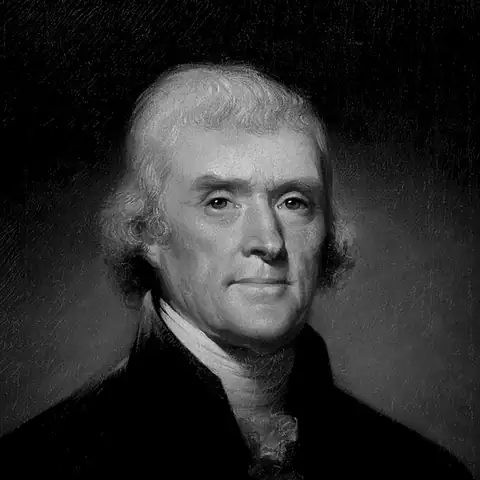
Who was Thomas Jefferson?
In 1776 Thomas Jefferson drafted the Declaration of Independence. Later he was Washington's Secretary of State, then John Adams's deputy, and from 1801 to 1809 he held the presidency. His party, the Democratic-Republicans, opposed Hamilton and the Federalists. It stood for cheap government, a literal reading of the Constitution and a land of independent farmers. As president he trimmed the debt and the army, scrapped the 1798 direct tax and purchased Louisiana, doubling the country's size. He also wrote Virginia's religious freedom law and set up the University of Virginia.
Political views
- Declared that people hold natural rights, including liberty and the pursuit of happiness, and that a government's power comes from the consent of the governed.Source: avalon.law.yale.edu
- Asked for a government that was wise and thrifty and that let citizens manage their own work and affairs.Source: avalon.law.yale.edu
- Maintained that states had the power to declare federal laws, the Sedition Act among them, unconstitutional.Source: avalon.law.yale.edu
- Described church and state as divided by a wall of separation.Source: loc.gov
- Favoured a nation of farmers and distrusted big factories and fast-rising immigration.Source: avalon.law.yale.edu
- Cut back the army, the navy and the debt, relying on the militia to defend the country.Source: millercenter.org
Legacy
The Declaration's words were taken up by later movements, abolitionists and civil rights marchers among them. Admirers say Jefferson advanced religious freedom, public schooling and a democratic outlook. People who want limited government and strong states also count him as a forebear. Critics stress the gap between what he wrote and how he lived. Over his lifetime he held more than 600 people in bondage, freed very few and oversaw slavery's growth into new land. Most historians accept that he fathered children with Sally Hemings, who was enslaved at Monticello. Racial claims in his Notes on Virginia show how narrow his idea of equality was. Other critics argue that buying Louisiana and imposing the Embargo broke his own literal reading of the Constitution.
In their own words
“A wise and frugal Government, which shall restrain men from injuring one another, shall leave them otherwise free to regulate their own pursuits of industry and improvement.”