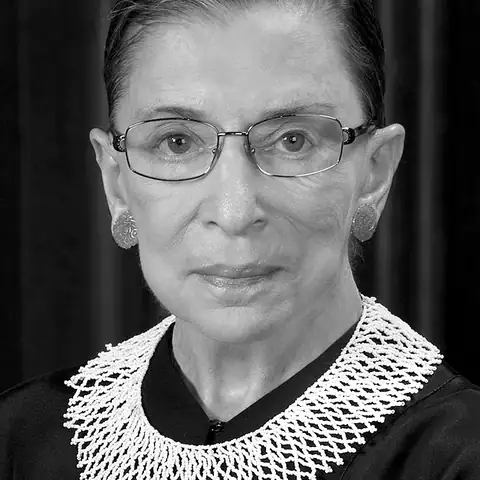
Who was Ruth Bader Ginsburg?
Ruth Bader Ginsburg was born in Brooklyn in 1933. She finished at the top of her Columbia Law School class in 1959, yet she could not find a job because she was a woman. She went on to teach at Rutgers, and in 1972 became the first woman with tenure on the Columbia law faculty. At the ACLU she helped start the Women's Rights Project, and she personally argued six sex-discrimination cases at the nation's highest court. Jimmy Carter made her a federal appeals judge in Washington in 1980. Bill Clinton chose her for the Supreme Court in 1993, and senators voted 96 to 3 to confirm her. She sat on the Court until she died in September 2020.
Political views
- In the 1970s she planned a legal campaign that included Frontiero v. Richardson and Weinberger v. Wiesenfeld, to get courts to treat laws that sort people by sex with suspicion.Source: en.wikipedia.org
- Wrote the Court's opinion in United States v. Virginia (1996), which ended male-only admissions at the Virginia Military Institute.Source: law.cornell.edu
- Lost Ledbetter v. Goodyear in 2007 as a dissenter and urged Congress to undo it, which it did through the Lilly Ledbetter Fair Pay Act.Source: oyez.org
- Backed abortion rights and dissented in Gonzales v. Carhart, but argued that Roe v. Wade had halted reform being made through the states.Source: en.wikipedia.org
- Dissented in Shelby County v. Holder (2013), where the Court struck down the formula that decided which places needed federal approval to change voting rules.Source: en.wikipedia.org
- Sided with civil liberties in Fourth Amendment cases. She dissented in Board of Education v. Earls, which allowed drug tests at school, and in Herring v. United States.Source: en.wikipedia.org
- Supported race-conscious admissions at universities, writing a concurrence in Grutter v. Bollinger and a dissent in Gratz v. Bollinger.Source: en.wikipedia.org
Legacy
Admirers say Ginsburg changed American law on sex discrimination, first as a litigator and later as a justice. In her last years she became a pop-culture icon under the nickname 'Notorious R.B.G.'. Conservative critics saw a dependable liberal vote who read the Constitution too broadly. Some liberals blame her for not stepping down while Democrats still ran the Senate in 2013-2014. When she died in 2020, Donald Trump filled her seat with Amy Coney Barrett. In 2016 she said sorry for comments about Trump as a candidate and for calling kneeling during the anthem 'really dumb'. Many people also remember her warm friendship with Antonin Scalia, her ideological opposite.
In their own words
“Once again, the ball is in Congress' court.”