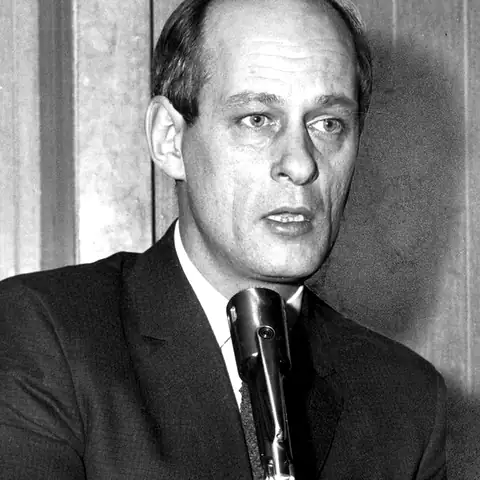
Who was René Lévesque?
Campbellton, New Brunswick, was the birthplace of René Lévesque in 1922, and he grew up in New Carlisle on the Gaspé Peninsula. He reported from Europe as a war correspondent and later became a television star at Radio-Canada. He won a seat as a Liberal in 1960 and became a leading minister in the Quiet Revolution under Jean Lesage. In 1967 he quit the Liberals and started the Mouvement Souveraineté-Association. In 1968 it became the Parti Québécois. His party won power in 1976, and he was premier until 1985. He died in 1987.
Political views
- In 1967 he started the Mouvement Souveraineté-Association, which sought a sovereign Quebec joined to Canada by an economic association.Source: biographi.ca
- He drove the plan to take over Quebec's private power companies. The 1962 election was fought on it, under the slogan 'Masters in our own house', and the voters said yes.Source: assnat.qc.ca
- His Charter of the French Language, called Bill 101, made French the usual language in workplaces, schools and shops. It also banned outdoor commercial signs in any other language.Source: en.wikipedia.org
- He held that English schools and language rights for the English-speaking minority must stay, even when some in his own party disagreed.Source: en.wikipedia.org
- He set up a public, compulsory car insurance scheme, which began in 1978.Source: biographi.ca
- In 1977 he ended secret election funds and brought in public funding of parties, with a ban on corporate gifts and a cap on individual gifts.Source: biographi.ca
- In the 1980 referendum he asked for permission to negotiate sovereignty-association. Sixty per cent of voters refused.Source: en.wikipedia.org
- In 1982, after the unions refused to give up benefits, he cut public sector pay by law.Source: biographi.ca
Legacy
Many Quebecers remember Lévesque as a democrat who pursued independence only by ballot and referendum. Admirers say he cleaned up party finance and gave French speakers more economic control, through Hydro-Québec and the language law. He once threatened to resign rather than end English public schools. Critics in English Canada, and among English-speaking and immigrant Quebecers, saw Bill 101, with its ban on English commercial signs, as a blow to minority rights. His pay cuts of 1982 also angered the public sector unions that had backed his party. In 1984 his 'beau risque' of working with Brian Mulroney's government upset committed sovereigntists, and some senior figures quit. His government refused to accept the 1982 constitution, and no Quebec premier has endorsed it since.