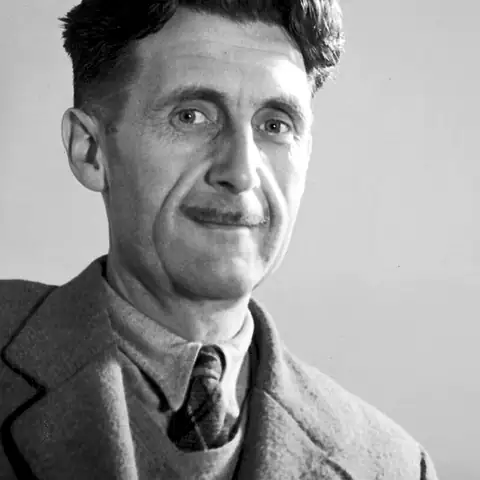
Who was George Orwell?
George Orwell was the pen name of Eric Blair, who was born in India in 1903 and went to school at Eton. He spent five years as a police officer in British Burma, and the job left him hostile to empire. Back in Europe he wrote about poor people in Down and Out in Paris and London and The Road to Wigan Pier. In Spain in 1937 he fought for the Republic with the POUM militia, was shot in the throat and saw communists crush his comrades. He told that story in Homage to Catalonia. He later worked at the BBC and the Tribune magazine, and his last two novels made him world famous. He died in 1950.
Political views
- He called for the state to take over land, mines, railways, banks and the big industries. He also wanted a cap on incomes of ten to one.Source: gutenberg.net.au
- He said that from 1936 on, every serious line he wrote was against dictatorship and for democratic socialism.Source: orwellfoundation.com
- He defended a free press and blamed British writers who stayed silent about the Soviet Union.Source: orwellfoundation.com
- He argued that India should get Dominion status straight away, with a right to leave the Empire.Source: gutenberg.net.au
- He drew a line between patriotism, which is love of a place and way of life, and nationalism, which he saw as a thirst for power.Source: orwellfoundation.com
- He backed the fight against Nazi Germany and held that being a patriot did not make a person a conservative.Source: orwellfoundation.com
Legacy
Words from Orwell, such as Big Brother, doublethink and Orwellian, are now part of everyday speech, and schools teach his essays as models of clear writing. People across the spectrum claim him. Socialists stress his democratic socialism and his dislike of empire, while conservatives and Cold War liberals stress his hatred of communism. In 1949 he gave a Foreign Office propaganda unit a list of writers he thought were communist sympathizers. Critics on the left call that informing. Defenders say the list was only meant to keep those writers out of anti-communist work. Some also point to rude remarks he made about certain groups. His books remain central to debates about surveillance and propaganda.
In their own words
“Every line of serious work that I have written since 1936 has been written, directly or indirectly, against totalitarianism and for democratic socialism, as I understand it.”
“If liberty means anything at all it means the right to tell people what they do not want to hear.”