12axes-testTake the test
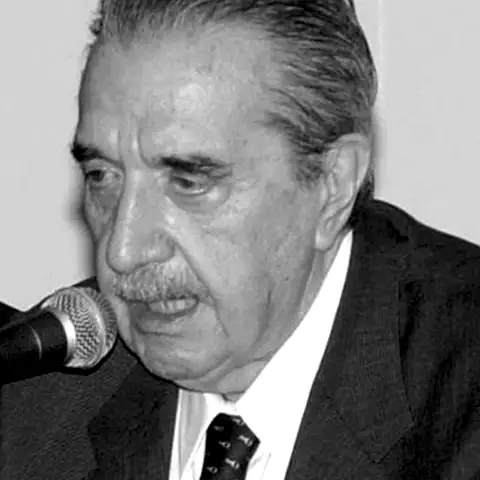
Raúl Alfonsín
Historical figureArgentina1927-2009

Raúl Alfonsín

President of Argentina (1983-1989) · Leader of the Radical Civic Union

Argentine lawyer and Radical Civic Union leader who, as the first president after the last military dictatorship, ordered the trial of the junta commanders and fought hyperinflation, leaving office early in 1989.

Profile on 12 axes9 of 12 documented
ECONOMYSTATESOCIETYWORLDOwnershipMarketsWelfareAuthoritySecurityStructureMoralityReligionTechnologyCultureTradeForeign
Where they stood

Raúl Alfonsín, axis by axis

  1. 01OwnershipNo clear record
    PublicPrivate
  2. PlannedFree

    His Austral Plan froze prices and wages and cut spending, which is state steering, but it also aimed at stabilizing a market economy. The score sits slightly on the planned side.

  3. SharedSelf-reliant
  4. DemocraticStrong leader
  5. LibertyOrder

    He put the junta commanders on trial, which points to liberty and the rule of law. He then accepted the Full Stop and Due Obedience laws under military pressure, so the score is not extreme.

  6. LocalCentral

    In 1986 he proposed moving the capital to Viedma, partly to spread power away from Buenos Aires. His government was otherwise a centralized presidency, so this is close to the middle.

  7. ProgressiveTraditional
  8. SecularReligious

    He passed a divorce law in 1987 over the opposition of the Catholic bishops, which suggests a secular lean.

  9. 09TechnologyNo clear record
    EmbraceCaution
  10. 10CultureNo clear record
    MulticulturalNational identity
  11. GlobalProtected

    He backed regional integration with Brazil, the seed of Mercosur. That is a mild lean to open trade.

  12. CooperationStrength

3 axes have no clear record, so matching leaves them out.

Who was Raúl Alfonsín?

Alfonsín was a lawyer who led the Radical Civic Union, or UCR, from 1981. In October 1983 he won 51.7 percent of the vote and became the first UCR candidate to beat a Peronist in a head-to-head presidential race. He took office on 10 December 1983, as military rule ended. His government created a commission under the writer Ernesto Sábato to document disappearances, and it brought the junta commanders to trial. He then faced barracks revolts, general strikes and runaway inflation. On 8 July 1989 he handed power to Carlos Menem about five months before his term ended. He died in 2009.

Political views

  • His government set up CONADEP, chaired by Ernesto Sábato, whose report recorded 8,960 cases of people forcibly disappeared during the dictatorship.Source: cidob.org
  • When the armed forces' own council upheld the army's anti-subversion campaign, his government turned to other courts to prosecute those responsible for human rights violations.Source: todo-argentina.net
  • The junta leaders were convicted in 1985, and Jorge Videla and Emilio Massera received life sentences.Source: cidob.org
  • After uprisings by the carapintada officers, Congress passed the Full Stop law in 1986 and the Due Obedience law in 1987, which limited prosecutions of lower-ranking officers.Source: cidob.org
  • His Austral Plan of June 1985 introduced a new currency, froze prices and wages and cut public spending. It failed by 1986 and 1987 as inflation returned.Source: cidob.org
  • The divorce law passed in June 1987, over strong opposition from the Catholic bishops.Source: cidob.org
  • In 1984 he accepted the papal settlement of the Beagle Channel dispute with Chile, and a non-binding plebiscite backed it by more than 10 million votes to 2.5 million.Source: todo-argentina.net
  • In 1985 he signed the Foz do Iguaçu declaration with Brazil's José Sarney, an early step toward the Mercosur trade bloc formed in 1991.Source: cidob.org

Legacy

Admirers credit Alfonsín with rebuilding civilian rule after a dictatorship that disappeared thousands of people, and with holding the generals to account in open court, which few governments in the region had done. Critics fault the Full Stop and Due Obedience laws, which shielded many officers from trial. Economists point to the failed Austral and Primavera plans and to the hyperinflation of 1989, which forced him out early. Within his own party, the 1993 Pact of Olivos with Menem is still disputed, since the UCR did badly in the 1994 convention vote.

How close are you to Raúl Alfonsín?

Take the 12 Axes test and see which historical figure is your political twin, axis by axis.

Take the test

Raúl Alfonsín: questions

Did Raúl Alfonsín put the military juntas on trial?

Yes. His government prosecuted the dictatorship's commanders, and the 1985 verdict convicted junta leaders. Videla and Massera received life terms. Lower-ranking officers later gained relief under the Full Stop and Due Obedience laws.

Why did Raúl Alfonsín leave office early?

Hyperinflation and a currency crisis hit in early 1989, followed by unrest in May. He handed the presidency to Carlos Menem on 8 July 1989, about five months before the end of his term.

What were the Full Stop and Due Obedience laws?

They were laws passed in 1986 and 1987, after army uprisings, that limited trials of lower-ranking officers for dictatorship-era crimes. Human rights groups criticized them, and the source describes them as costly to his reputation.

Sources

Portrait: Argentina.RaulAlfonsin.01.jpg by Roosewelt Pinheiro, CC BY 3.0 br, via Wikimedia Commons. Cropped and converted to grayscale by 12axes-test.com.