12axes-testTake the test
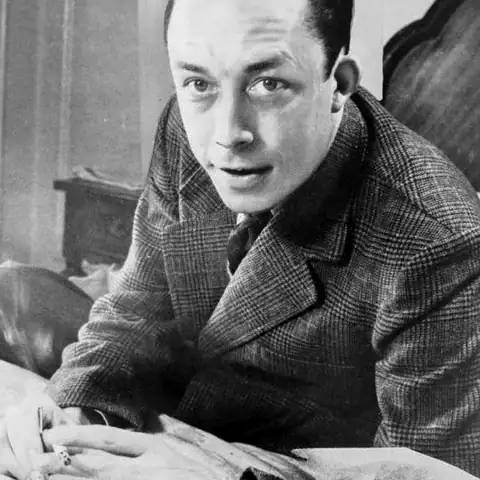
Albert Camus
Historical figureFrance1913-1960

Albert Camus

Novelist, essayist and philosopher · Editor of the Resistance newspaper Combat

Franco-Algerian novelist and thinker who urged people to rebel against injustice without turning to terror, broke with communism, fought the death penalty and sought peace in Algeria.

Profile on 12 axes10 of 12 documented
ECONOMYSTATESOCIETYWORLDOwnershipMarketsWelfareAuthoritySecurityStructureMoralityReligionTechnologyCultureTradeForeign
Where they stood

Albert Camus, axis by axis

  1. PublicPrivate

    He belonged to the non-Communist left and leaned toward libertarian socialism, but he never wrote a detailed economic plan, so his economic scores stay moderate.

  2. PlannedFree
  3. SharedSelf-reliant
  4. DemocraticStrong leader
  5. LibertyOrder

    After the purge trials that followed the liberation, he turned against the death penalty for life, and he argued that political violence is seldom justified.

  6. 06StructureNo clear record
    LocalCentral
  7. ProgressiveTraditional
  8. SecularReligious
  9. EmbraceCaution

    This score rests on his sharp attacks on the atomic bombings and on nuclear arms. He wrote little about technology in general.

  10. MulticulturalNational identity

    On Algeria he wanted one country shared by Muslims and European settlers. He opposed the FLN and colonial abuses alike, and almost nobody backed his view.

  11. 11TradeNo clear record
    GlobalProtected
  12. CooperationStrength

    He supported a European federation from 1944, and in 1952 he quit UNESCO because Franco's Spain was admitted.

2 axes have no clear record, so matching leaves them out.

Who was Albert Camus?

Albert Camus grew up in a poor family in Algiers, where he was born in 1913 in what was then French Algeria. As a young man he briefly joined the Communist Party but was expelled over his stance on Algeria. In the Second World War he worked with the Resistance and edited its paper, Combat. He became famous for novels and essays such as The Stranger, The Plague and The Rebel. Politically he stood on the independent left. He distrusted ideologies that excuse killing for a future goal. He won the Nobel Prize in Literature in 1957. A car crash killed him in 1960, when he was 46.

Political views

  • Taught that the world has no built-in meaning and that the honest response is to rebel against injustice, not to flee into false hope or end one's life.Source: plato.stanford.edu
  • Wrote in The Rebel that revolutions, and Marxism in particular, end up excusing mass killing in the name of history, and argued that politics needs limits.Source: plato.stanford.edu
  • Wanted the death penalty ended and made the case in Reflections on the Guillotine, published in 1957.Source: iep.utm.edu
  • Asked both sides in Algeria to stop killing civilians, and criticised the FLN's violence as well as abuses by French colonial rule.Source: en.wikipedia.org
  • Protested against Stalinism and against the Soviet crushing of the Hungarian uprising in 1956.Source: en.wikipedia.org
  • Favoured closer unity among European states and condemned the atomic bombing of Hiroshima and Nagasaki.Source: en.wikipedia.org

Legacy

Admirers praise Camus for refusing to defend killing for a cause, whichever side it came from. He spoke against the death penalty and against Soviet repression when many French intellectuals stayed quiet. His quarrel with Sartre made him a symbol of the anti-totalitarian left. Critics say he was blind to the injustice of colonial rule and failed to back Algerian independence. Some call his silence on that question a moral failure. His remark after the Nobel Prize, often quoted as putting his mother before justice, is still argued over. His books remain widely read as a defence of human dignity without religious or party certainty.

In their own words

“I revolt, therefore we are”
The Rebel, 1951 (English translation)

How close are you to Albert Camus?

Take the 12 Axes test and see which historical figure is your political twin, axis by axis.

Take the test

Albert Camus: questions

Was Albert Camus a communist?

He joined the French Communist Party in the 1930s but was pushed out after he would not drop his criticism of French rule in Algeria. Later he attacked Soviet communism in print, most of all in The Rebel.

Why did Camus break with Sartre?

The Rebel, published in 1951, condemned revolutionary violence and the intellectuals who defended Soviet communism. Sartre's journal answered with a harsh review, and the two men ended their friendship in public.

What did Camus believe about Algeria?

He hoped Muslims and European settlers could share a single country. He condemned FLN attacks and colonial abuses alike, and asked for a truce that protected civilians. Both camps mostly rejected this middle path.

Sources