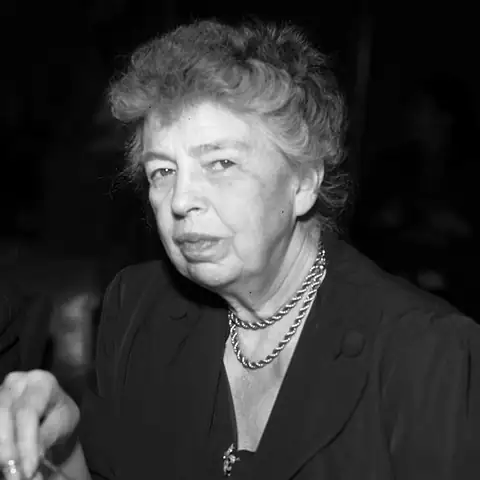
Who was Eleanor Roosevelt?
Eleanor Roosevelt was born in New York City in 1884 and was an orphan while still a child. She married her distant cousin Franklin D. Roosevelt in 1905. In the 1920s she took an active part in New York's Democratic politics. When Franklin became president, she used the White House years of 1933 to 1945 to hold press conferences, write a daily column called My Day and press for New Deal measures. Truman sent her to the new United Nations in 1945. There she headed the group that drafted the 1948 human rights declaration. She remained a major Democratic voice until her death in 1962.
Political views
- Pressed for New Deal relief aimed at women, young people and artists, and helped set up the National Youth Administration.Source: www2.gwu.edu
- Described racial prejudice as undemocratic and immoral. She backed an anti-lynching law and opposed the poll tax.Source: www2.gwu.edu
- In 1939 she quit the Daughters of the American Revolution after it would not let Marian Anderson sing in its hall.Source: www2.gwu.edu
- Favoured national health insurance and laws for full employment, and called the Taft-Hartley Act a bad bill.Source: www2.gwu.edu
- Headed the drafting committee for the 1948 human rights declaration, and is widely seen as the person who drove it through.Source: un.org
- Was among the first well-known liberals to stand against Joseph McCarthy. She also spoke against the Smith Act and the House Un-American Activities Committee.Source: www2.gwu.edu
- Chaired the commission on women's status set up by President Kennedy and testified for equal pay laws.Source: www2.gwu.edu
Legacy
Many rank Eleanor Roosevelt as the most influential First Lady in American history. Fans say she remade the post, used it to help the poor and to advance civil rights and labor, and later helped to build today's human rights system. Truman gave her the title First Lady of the World. In her own day she was often under attack. Southern segregationists hated her civil rights work, conservatives disliked her wartime claim that racism and fascism were linked, and in 1942 pressure from Congress pushed her out of the Office of Civilian Defense. Historians note that for decades she resisted the Equal Rights Amendment, and that she backed integration firmly only in the 1950s. Reportedly, her biggest regret was not pushing Franklin to let in more refugees from Nazism.