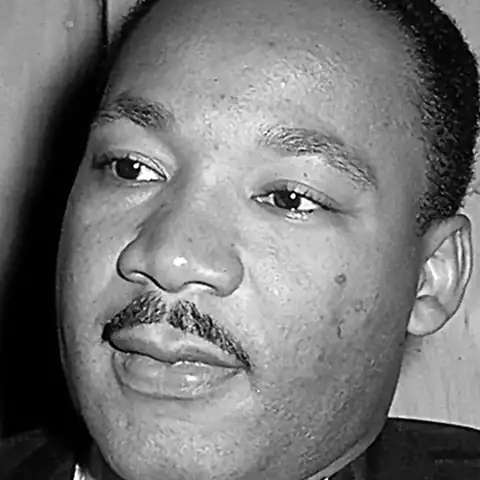
Who was Martin Luther King Jr.?
Atlanta was the birthplace of Martin Luther King Jr., in 1929, and he went into the Baptist ministry. He became known nationwide when he guided the bus boycott in Montgomery, Alabama, that ran from 1955 to 1956. In 1957 he was a founder of the Southern Christian Leadership Conference, and its first president. Protest campaigns followed in Birmingham, Selma and other cities, and at the March on Washington in 1963 he gave the I Have a Dream speech. In 1964 he won the Nobel Peace Prize. A gunman killed him in Memphis in April 1968, where he was backing a strike by sanitation workers.
Political views
- He joined the Christian teaching on love to Gandhi's method of nonviolence, which he saw as one of the strongest tools open to oppressed people.Source: kinginstitute.stanford.edu
- He defended breaking laws that propped up segregation, likening it to Shadrach, Meshach and Abednego and to the Boston Tea Party.Source: kinginstitute.stanford.edu
- He turned down calls for patience, writing that to Black Americans 'wait' had nearly always meant 'never'.Source: kinginstitute.stanford.edu
- In 1967 he spoke out against the Vietnam War, saying it hurt poor Americans and Vietnamese villagers alike, and he asked for a revolution of values.Source: kinginstitute.stanford.edu
- His Poor People's Campaign demanded work, unemployment insurance, a living minimum wage and schooling for poor children and adults.Source: kinginstitute.stanford.edu
- Accepting the Nobel Prize, he said nonviolence answers the central political and moral question of the age.Source: nobelprize.org
Legacy
Few Americans are as widely celebrated. A national holiday carries his name, and his campaigns added pressure that led to two landmark laws: the 1964 Civil Rights Act and the 1965 Voting Rights Act. People of many political views admire his moral leadership and his insistence on nonviolence. While he lived, though, large numbers of white Americans disliked him, some fellow activists found him too careful, and newspapers and allies turned on him when he came out against the Vietnam War. Historians still argue about how his later calls for economic change fit with his earlier civil rights work.
In their own words
“I refuse to accept the view that mankind is so tragically bound to the starless midnight of racism and war that the bright daybreak of peace and brotherhood can never become a reality.”