12axes-testTake the test
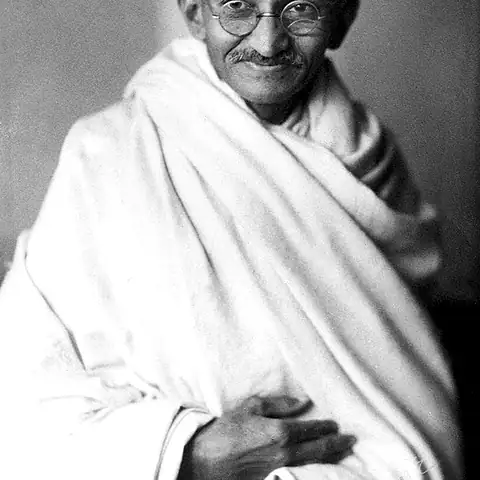
Mahatma Gandhi
Historical figureIndia1869-1948

Mahatma Gandhi

Leader of the Indian independence movement · Lawyer and civil rights campaigner in South Africa

Indian lawyer and leader who built the method of satyagraha, or nonviolent resistance, and led the campaign against British rule while urging unity between religions.

Profile on 12 axesAll 12 documented
ECONOMYSTATESOCIETYWORLDOwnershipMarketsWelfareAuthoritySecurityStructureMoralityReligionTechnologyCultureTradeForeign
Where they stood

Mahatma Gandhi, axis by axis

  1. PublicPrivate

    He favored village production and told the rich to use their wealth for the community, but never asked for state control. Scored mildly public.

  2. PlannedFree
  3. SharedSelf-reliant

    His ideal paired village self-reliance with a duty to look after the poor, so the score is mixed.

  4. DemocraticStrong leader
  5. LibertyOrder
  6. LocalCentral
  7. ProgressiveTraditional

    He fought untouchability, which was a reforming cause, but he also called for personal austerity and traditional self-restraint. This is a judgment call.

  8. SecularReligious

    He built politics on religious ethics and friendship between faiths, not on a state religion.

  9. EmbraceCaution

    Scored from Hind Swaraj, where he called machinery a great sin and the main sign of modern civilization. His views eased somewhat later.

  10. MulticulturalNational identity

    He backed Indian self-rule and swadeshi, but held that India was one nation whatever its faiths. That places him near the middle.

  11. GlobalProtected
  12. CooperationStrength

Who was Mahatma Gandhi?

Mohandas Gandhi was born in Porbandar, in what is now Gujarat, and trained as a lawyer in London. He moved to South Africa in 1893 and spent years campaigning there against laws that targeted Indians. It was in that fight that he worked out satyagraha, meaning truth force. He went back to India in 1915 and rose to the top of the Indian National Congress. Between the two world wars he led mass campaigns of peaceful protest against British rule. People called him Mahatma, or great soul. He was shot dead in January 1948, a few months after India became independent.

Political views

  • Taught that unjust laws should be broken in the open, with the penalty accepted, and that nonviolence was a principle and not just a tactic.Source: nobelprize.org
  • Held that soul-force was a stronger way to win rights than physical force.Source: mkgandhi.org
  • Saw modern machinery as the leading symbol of modern civilization and held it responsible for India's poverty.Source: mkgandhi.org
  • Promoted swadeshi, which meant buying Indian handmade cloth instead of imported goods, and asked rich Indians to pay for hand-looms.Source: mkgandhi.org
  • Said India could not stop being one nation just because its people followed different religions.Source: mkgandhi.org
  • Worked to bring Hindus, Muslims and Christians together, and campaigned to end the stigma of untouchability in Hindu society.Source: nobelprize.org

Legacy

In India Gandhi is honoured as the Father of the Nation. His methods influenced Martin Luther King Jr., Nelson Mandela and many other movements worldwide. The Nobel Committee considered him for the Peace Prize several times and never gave it, something it later said it regretted. His critics came from many sides. Some revolutionaries thought nonviolence too weak. Hindu nationalists disliked his outreach to Muslims. Dalit leaders, B. R. Ambedkar among them, rejected the way he handled caste. Historians also argue over what he wrote about Black Africans while in South Africa.

In their own words

“Machinery is the chief symbol of modern civilization; it represents a great sin.”
Hind Swaraj or Indian Home Rule, chapter 19, 1909

How close are you to Mahatma Gandhi?

Take the 12 Axes test and see which historical figure is your political twin, axis by axis.

Take the test

Mahatma Gandhi: questions

What is satyagraha?

It means truth force. Gandhi used it for a method of nonviolent resistance in which people refuse to obey unjust laws and accept the punishment without fighting back.

Was Gandhi against technology?

In Hind Swaraj he sharply condemned machinery as the heart of modern civilization. He promoted hand-spinning and village industry, though his views softened somewhat later in life.

Why is Gandhi criticized?

Some revolutionaries thought his nonviolence was too weak. Hindu nationalists attacked his outreach to Muslims, and Dalit leaders including B. R. Ambedkar disputed his approach to caste. His early writing on race in South Africa is also debated.

Sources