12axes-testTake the test
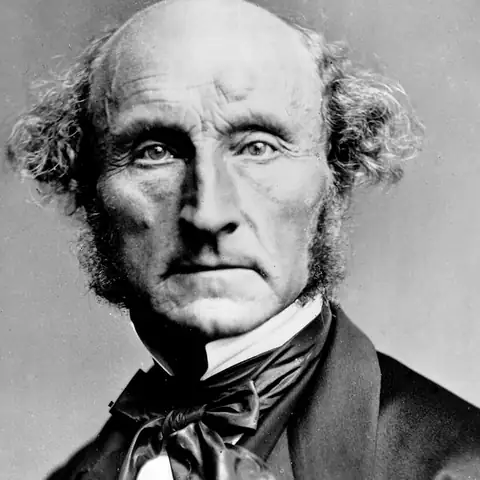
John Stuart Mill
Historical figureUnited Kingdom1806-1873

John Stuart Mill

Philosopher and economist · Member of Parliament for Westminster (1865-1868)

English philosopher and MP whose On Liberty set out the harm principle, and whose writing on representative government and women's equality helped shape modern liberalism.

Profile on 12 axesAll 12 documented
ECONOMYSTATESOCIETYWORLDOwnershipMarketsWelfareAuthoritySecurityStructureMoralityReligionTechnologyCultureTradeForeign
Where they stood

John Stuart Mill, axis by axis

  1. PublicPrivate

    He saw profit as a fair reward for capitalists, but in later work warmed to worker co-operatives and some forms of socialism.

  2. PlannedFree
  3. SharedSelf-reliant
  4. DemocraticStrong leader

    He backed representative democracy and votes for women. But he also wanted extra votes for the educated as a shield against rule by the uninformed majority.

  5. LibertyOrder
  6. LocalCentral
  7. ProgressiveTraditional
  8. SecularReligious
  9. EmbraceCaution

    He welcomed scientific and industrial progress, yet he also pictured a future stationary economy and did not treat endless growth as the goal.

  10. MulticulturalNational identity

    His book on representative government held that free institutions do best among people of one nationality. That pulls the score a little to the positive side.

  11. GlobalProtected
  12. CooperationStrength

    Mill served the East India Company for decades and accepted colonial rule over peoples he thought unready to govern themselves. He was no militarist, so he lands in the middle.

Who was John Stuart Mill?

John Stuart Mill was born in London in 1806. His father, James Mill, taught him at home from a very young age within the circle of the reformer Jeremy Bentham. For many years Mill worked at the East India Company, rising to chief examiner, the post his father had held. Alongside that job he produced his major books, among them A System of Logic, Principles of Political Economy, On Liberty, Utilitarianism and The Subjection of Women. He said his wife, Harriet Taylor Mill, shaped much of his thinking. Voters sent him to Parliament as a Liberal MP for Westminster, where he served between 1865 and 1868. He died in 1873.

Political views

  • Held that the only good reason to use power against someone's will is to stop them harming others.Source: gutenberg.org
  • Defended free thought, speech and ways of living, and warned that the opinion of the majority can become a tyranny of its own.Source: plato.stanford.edu
  • Spoke for votes for women in the Commons, and in The Subjection of Women argued the sexes should be equal under the law.Source: iep.utm.edu
  • Accepted private property and markets but turned down pure laissez-faire, arguing that government has duties that serve the common good.Source: plato.stanford.edu
  • Suggested that worker-owned co-operatives could make the workplace a school of fellow feeling.Source: plato.stanford.edu
  • Wanted a limit on how much one person could receive through gifts or inheritance, and higher taxes on big inheritances.Source: gutenberg.org
  • Favoured proportional representation, and extra votes for the better educated.Source: plato.stanford.edu

Legacy

Many call Mill the most influential English-language thinker of the 19th century, and On Liberty is still a core text in arguments over free speech and personal choice. Liberals, libertarians and social democrats each claim a share of him, from the harm principle to his interest in co-operatives. Critics on the right say his individualism wears away shared moral traditions. Others point to his defence of British rule in India, and to his plan for extra votes for the educated, as limits on his belief in equality. Feminist scholars credit Mill and Harriet Taylor Mill as early champions of women's rights.

In their own words

“The only purpose for which power can be rightfully exercised over any member of a civilised community, against his will, is to prevent harm to others.”
On Liberty, Chapter I, 1859

How close are you to John Stuart Mill?

Take the 12 Axes test and see which historical figure is your political twin, axis by axis.

Take the test

John Stuart Mill: questions

What is the harm principle?

It is Mill's rule that society may only limit a person's freedom to stop harm to other people. Being offended, or doing something risky to yourself, is not enough. He set it out in On Liberty in 1859.

Was John Stuart Mill a liberal?

Yes. He sat as a Liberal MP and is one of the key thinkers of liberalism. His ideas have also been used by libertarians and social democrats.

Was Mill a socialist?

Not fully. He defended private property and markets, but he grew open to co-operatives and some socialist ideas in his later work. He is better described as a reforming liberal.

Sources