12axes-testTake the test
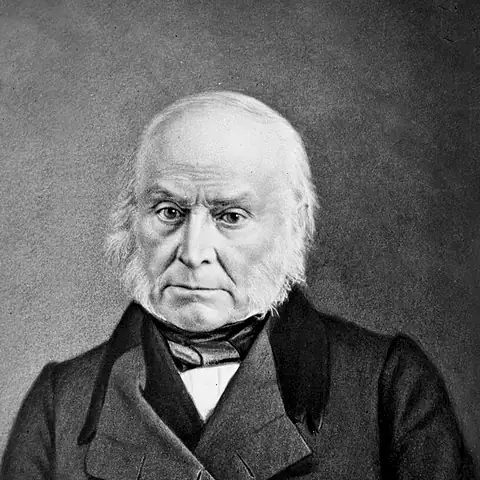
John Quincy Adams
Historical figureUnited States1767-1848

John Quincy Adams

6th President of the United States (1825-1829) · U.S. Secretary of State

Sixth president, diplomat and later congressman who wanted national roads, canals and science, and who fought the House gag rule on antislavery petitions.

Profile on 12 axes9 of 12 documented
ECONOMYSTATESOCIETYWORLDOwnershipMarketsWelfareAuthoritySecurityStructureMoralityReligionTechnologyCultureTradeForeign
Where they stood

John Quincy Adams, axis by axis

  1. PublicPrivate
  2. PlannedFree

    Wanted Washington to help build a national market through roads, canals and similar public works, while the economy itself stayed private.

  3. SharedSelf-reliant

    The federal government ran no welfare system then. His score reflects support for national spending on schooling and science, not redistribution.

  4. DemocraticStrong leader
  5. LibertyOrder

    Scored toward liberty because he spent years in Congress fighting the gag rule on antislavery petitions and defending the Amistad captives.

  6. LocalCentral
  7. 07MoralityNo clear record
    ProgressiveTraditional

    His later stand against slavery is covered elsewhere. No recorded view on family or social norms beyond the conventions of his time, so this axis is left blank.

  8. 08ReligionNo clear record
    SecularReligious

    He was personally devout, but the sources show no plan for religion in public life, so this axis is left blank.

  9. EmbraceCaution

    Scored toward embracing it, as he called for a national observatory and university and backed federal improvements.

  10. 10CultureNo clear record
    MulticulturalNational identity

    No recorded view on immigration or cultural diversity in the sources, so this axis is left blank.

  11. GlobalProtected

    Accepted the very protective Tariff of 1828, stricter than he would have chosen, as part of his wider support for the American System.

  12. CooperationStrength

    A career diplomat who preferred negotiated deals and backed sending delegates to the 1826 Panama Congress, though he also had a hand in drafting the unilateral Monroe Doctrine.

3 axes have no clear record, so matching leaves them out.

Who was John Quincy Adams?

John Quincy Adams, son of the second president, spent his early career as a diplomat in Europe. He took part in the talks at Ghent that ended the War of 1812, then served James Monroe as secretary of state. The 1824 election had no clear winner, and the House chose him as president. Andrew Jackson's followers charged that he had made a corrupt deal with Henry Clay. In office he offered a broad plan for roads, canals, education and science, but Congress mostly turned it down, and Jackson beat him in 1828. From 1831 until he died he sat in the House, where he grew into a leading critic of slavery's political power.

Political views

  • His 1825 message to Congress called for roads, canals, a national university and an astronomical observatory, on the theory that liberty is power.Source: millercenter.org
  • Favored federal money for internal improvements and protective tariffs, in line with Henry Clay's American System.Source: millercenter.org
  • Signed the Tariff of 1828, which Southern opponents called the Tariff of Abominations, and which set duties higher than he had planned.Source: millercenter.org
  • Pressed to send American delegates to the Panama Congress of the newly independent Latin American states, despite fierce Southern objections.Source: millercenter.org
  • As a congressman he helped bring an end to the House gag rule that blocked debate on slavery.Source: millercenter.org
  • In 1841 he argued in the Supreme Court that the Africans who had taken over the slave ship Amistad should go free.Source: history.state.gov

Legacy

Many historians rank Adams among America's finest diplomats, crediting him with the Adams-Onís Treaty with Spain and with shaping the Monroe Doctrine. Admirers also cite his plans for science, schooling and transport, which pointed toward later national programs, and his late-life work for the Amistad captives and for the right to petition Congress. Critics in his day said his plans stretched federal power too far, and Jacksonians called his 1824 win a corrupt bargain. Most historians count his presidency as a failure, noting his poor ties with Congress and his unwillingness to hand out jobs or build a party. The 1828 tariff also added to Southern anger that fed the Nullification Crisis.

In their own words

“Let us not be unmindful that liberty is power; that the nation blessed with the largest portion of liberty must in proportion to its numbers be the most powerful nation upon earth.”
First Annual Message to Congress, 1825

How close are you to John Quincy Adams?

Take the 12 Axes test and see which historical figure is your political twin, axis by axis.

Take the test

John Quincy Adams: questions

Did John Quincy Adams oppose slavery?

Yes, especially later in life. As a congressman he fought the gag rule that stopped slavery petitions from being heard. In 1841 he argued for the freedom of the Amistad captives.

Why did John Quincy Adams lose in 1828?

Andrew Jackson's supporters had never accepted the 1824 result and called it a corrupt bargain. Adams also had weak ties with Congress, and his large federal plans found little support.

What was John Quincy Adams known for as secretary of state?

He was a leading negotiator of the Adams-Onís Treaty with Spain and helped shape the Monroe Doctrine, which warned European powers away from the Americas.

Sources