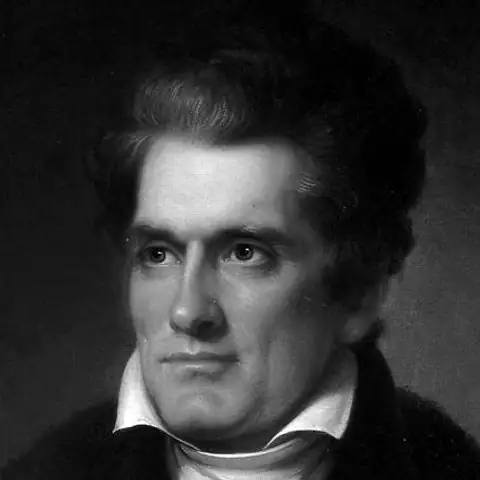
Who was John C. Calhoun?
John C. Calhoun, a planter and lawyer in South Carolina, filled almost every national office except the presidency. In Congress from 1811, he was a War Hawk who urged war with Britain in 1812. In those years he also favored a stronger army, better roads and a national bank. Monroe made him Secretary of War, and he then served as vice president for both John Quincy Adams and Andrew Jackson, quitting in 1832 amid the nullification crisis. As senator, and later as John Tyler's Secretary of State, he emerged as the most important political thinker defending slavery and Southern rights. He died in 1850.
Political views
- In 1837 he told the Senate that slavery was a positive good and not an evil.Source: clemson.edu
- His anonymous South Carolina Exposition and Protest of 1828 said a state could veto federal laws it thought unconstitutional, starting with the protective tariff.Source: en.wikipedia.org
- He held that Congress could use its tariff power to raise revenue only, never to shield home industry.Source: teachingamericanhistory.org
- His idea of the concurrent majority would let affected states block federal action. He laid it out in A Disquisition on Government.Source: clemson.edu
- As Secretary of State he pushed for annexing Texas so that slavery could spread.Source: en.wikipedia.org
- He stood against the war with Mexico, against the Wilmot Proviso on banning slavery in conquered land, and against the Compromise of 1850.Source: en.wikipedia.org
- He taught that secession could be defended if nullification and compromise both failed.Source: clemson.edu
Legacy
Some have long admired Calhoun for original ideas about restraining a majority. A Senate committee led by John F. Kennedy picked him in 1957 for its list of the Senate's greatest members. Critics such as the historian Richard Hofstadter say his concurrent majority shielded propertied minorities, not minorities as a whole, and was built to defend slavery. He enslaved dozens of people at Fort Hill, and his arguments on slavery in the territories were repeated later in the Dred Scott case. Many see his stand on nullification and sectional rights as groundwork for secession and civil war. Yale renamed its Calhoun College in 2017, and the city of Charleston took down his monument in 2020.