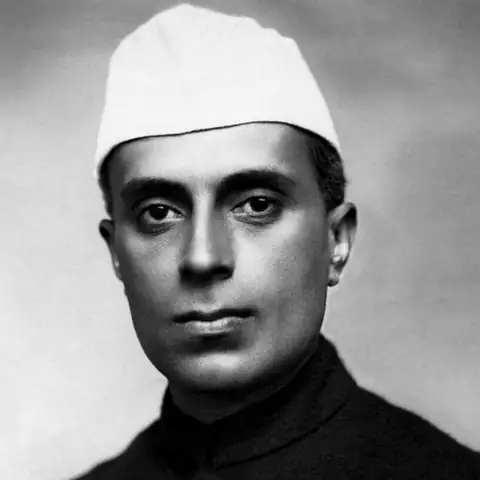
Who was Jawaharlal Nehru?
Born in Allahabad in 1889, Jawaharlal Nehru studied at Harrow, then Cambridge, and trained as a lawyer at the Inner Temple in England. He entered the Indian National Congress in 1919 and became a close partner of Mohandas Gandhi. British authorities jailed him many times for civil disobedience. Congress chose him as its president in 1928, and he took a leading part in the talks that led to independence. On 15 August 1947 he became prime minister of free India, and he also ran foreign affairs. He stayed in power until he died in 1964, which gave him seventeen years to set the country's course.
Political views
- He backed a moderate form of socialism and committed India to industrial growth through national plans.Source: bbc.co.uk
- He opposed splitting India along religious lines, and in 1947 he accepted partition with reluctance.Source: bbc.co.uk
- He held that people of every faith were equally Indian with equal rights, and he rejected communalism.Source: en.wikisource.org
- He said India's task was to end poverty, ignorance, disease and unequal chances in life.Source: en.wikisource.org
- He called his stance toward the superpowers 'positive neutrality', and it made him a leading figure among the non-aligned nations.Source: bbc.co.uk
- He built big state industries, dams and universities so that India could stand on its own.Source: inc.in
- He sent troops to Kashmir in 1947 to defend India's claim, and the fighting ended in a ceasefire arranged by the UN.Source: bbc.co.uk
- He pushed land reform, and when the courts blocked it he changed the constitution instead of fighting the judges.Source: inc.in
Legacy
Congress calls Nehru the father of Indian democracy. It credits him with regular elections, secular institutions, science teaching and an independent foreign line. Admirers add that India stayed democratic while poor, which few new states managed. Critics say his planned economy and permit system held growth back for decades. They also say Kashmir became a lasting quarrel on his watch, and that his China policy left the army unready for the defeat of 1962. Some ask how far he paved the way for family rule, since his daughter Indira Gandhi and her son Rajiv Gandhi both became prime ministers. India marks his birthday, 14 November, as Children's Day.
In their own words
“All of us, to whatever religion we may belong, are equally the children of India with equal rights, privileges and obligations.”