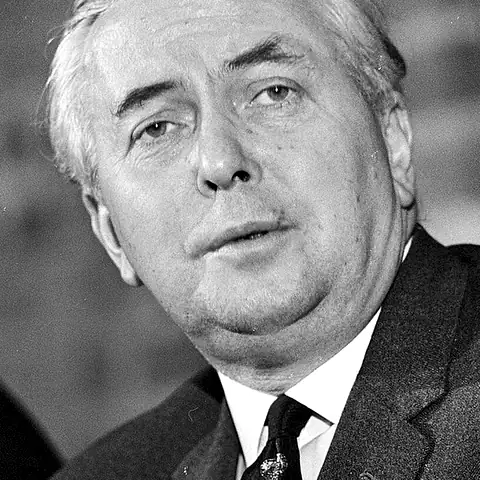
Who was Harold Wilson?
Harold Wilson was raised in Huddersfield by a chemist and a teacher. He took a first in Politics, Philosophy and Economics at Oxford. He became an MP in 1945, and at just 31 he joined Clement Attlee's cabinet at the Board of Trade. Labour chose him as leader in 1963 after the sudden death of Hugh Gaitskell. Of the five general elections he fought as leader, he won four. He governed from 1964 to 1970, lost power, then returned in 1974. In March 1976 he stunned the country by resigning. His last term was marked by high inflation, strikes, the 1975 vote on Europe and the failure to calm Northern Ireland. He entered the Lords in 1983 and died in 1995.
Political views
- Reopened the terms of Britain's place in the European Economic Community in 1974 and 1975, then put the result to a national vote.Source: gov.uk
- Promised in 1964 to end poverty in a country rich enough to afford plenty, and to bring the social services into one coordinated effort.Source: api.parliament.uk
- Set up the Department for Economic Affairs to produce a National Plan for growth.Source: gov.uk
- Stopped hanging for murder in 1965 across England, Scotland and Wales.Source: gov.uk
- Founded the Open University and brought in measures against unfair treatment of women and ethnic minorities.Source: gov.uk
- Cut the value of the pound in 1967 and announced that Britain would pull its forces out of east of Suez.Source: gov.uk
- Kept British troops out of Vietnam, even while staying close to the United States.Source: gov.uk
Legacy
Wilson's admirers say he held a divided Labour Party together, passed liberal social laws, widened access to university and kept Britain out of Vietnam. Critics on the right blame him for the pound's crises, devaluation, steep top tax rates and rising unemployment. Some on the left said he let socialist hopes fade. Biographers often call him an honest broker abroad. Fans see great skill in how he handled his party, while opponents say he thought too much about the next headline and too little about the long term. On the 12 axes he scores clearly toward public ownership, planning, shared welfare and embracing technology.
In their own words
“no longer do we have the scandal of poverty in the midst of great potential abundance”